



A remote work day. I start typing a question into the chat, then delete it.
I think, ‘Should I really be asking this?’ or ‘They look busy, I should try looking it up myself a bit more,’ and before I know it, 30 minutes have passed.
On the other hand, the boss receiving the message is actually struggling, too. When the chat is quiet, is it because things are going well, or because they are stuck? Through a screen, you just can’t tell.
This article is based on my (the author’s) experience as a middle manager. When I was a new hire, the option of remote work didn’t exist. I went to the office every day and learned the job right next to my seniors and bosses. Now, I am in a position to oversee subordinates in a workplace that mixes remote work and office attendance.
To be clear, I am not against remote work. No commute, ability to focus, easier to balance with life—these are all genuine benefits.
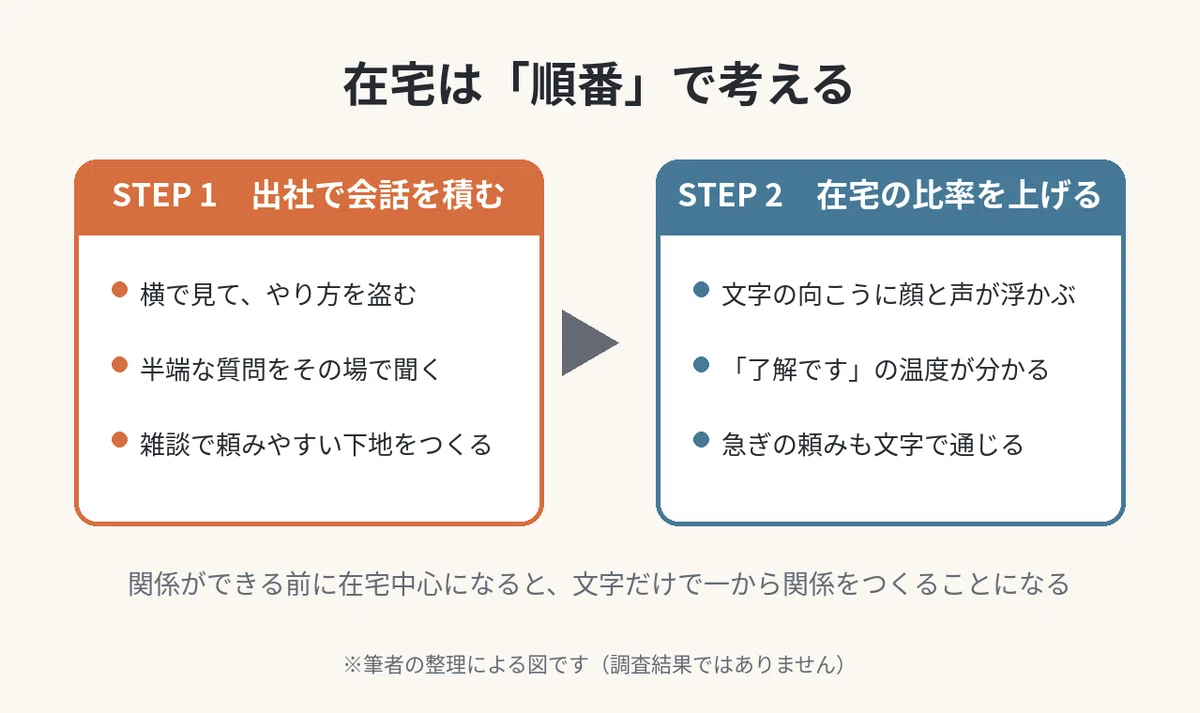
However, having experienced both, I think that remote work works better after human relationships have been established. It’s not a binary choice between office or remote, but a matter of timing.
For those wondering whether to go to the office or work remotely, I have compiled what meaning there is in going to the office just to talk, what has actually helped me, survey data, and how to use your office days starting tomorrow.
Even the younger generation answers that ‘in-person is better’ for casual conversation
Some might feel that the ‘benefits of going to the office’ are just an assumption held by older generations.
According to a fiscal year 2025 survey by the Ministry of Land, Infrastructure, Transport and Tourism, 16.8% of employed workers engaged in telework in the past year, indicating that the number, which had been declining since the pandemic, has turned to an increase and has stabilized. Remote work is no longer a special way of working.
Furthermore, looking at a survey conducted by Mynavi of university and graduate students graduating in 2026 (September 2025, 1,268 respondents), interesting results emerge.
Think ‘telework improves work-life balance’: 80.5%
Do not think ‘telework makes workplace communication easier’: 57.1%
Ideal is ‘all telework’: 4.8%
Ideal means of casual conversation/breaks is ‘in-person’: 85.7%
I understand the benefits of remote work. But I want to have casual conversations and light interactions face-to-face. Perhaps it is precisely because they have experienced online classes that they feel this way.
I believe the value of going to the office lies in the ‘gaps’ between meetings and the work itself. Most of what I have gained from going to the office was found there.
You can ‘watch and steal’ how work is done
When I was a new hire, what I learned the most from wasn’t training or manuals, but the conversations I overheard from the desk next to me.
How a boss gives instructions to a subordinate
How a senior colleague reports to their boss
How they speak to people outside the company
How they answer the phone and how they end the call
No one will ‘teach’ you these things. But you hear them every day.
For example, what is the first thing you say when you need to convey something difficult? Where do you start when talking to someone who is angry? How much of a reason do you give when turning down a request? These things are hard to put into writing and difficult to turn into a manual. That is precisely why you have to listen from the sidelines, think ‘Oh, so that’s how you say it,’ and store it away for yourself.
When working from home, this part is completely missing. Only the results remain in the chat, and the way a phone call is initiated or the moment someone changes their tone after seeing the other person’s reaction leaves no trace anywhere.
By the way, this doesn’t seem to be a feeling unique to Japan. In a study by American economists and others examining software engineers at major companies (Emanuel, Harrington, Pallais), engineers whose entire team was in the same building received about 22% more feedback on their code than engineers whose teammates were in a different building. When offices closed and everyone started working from home, that difference almost disappeared. And the effect of being nearby was especially significant for those who had just joined the company or were young.
This means that even for work that can be completed online, just being nearby changes how ‘easy it is to ask questions.’
Another use: Understanding how you are perceived
It’s not just methods that you can learn by watching.
How does the same boss treat other people? By watching that, you can compare it to how they treat you. They check in with others in detail, but they leave things to me. Conversely, they are overly polite when explaining things only to me. Such differences are quite honest indicators of how the other person views you.
If you only have one-on-one interactions, you have no one to compare with, so you cannot understand this.
Solving problems quickly with a brief word
What helped me while working in the office was not meetings, but casual chats and brief words.
Solving problems quickly To ask a question in a chat, you need to organize the question into a ‘question format.’ What don’t you understand? How far have you researched? You can’t send it until you can put it into words. If you are face-to-face, you can speak up even in a half-baked state, like ‘I feel like this is a bit strange.’ The other person can just peek at the screen and say, ‘Oh, that’s because…’ and it’s over. Things that would take many back-and-forth messages in a chat can sometimes be resolved in a minute.
Making it easier to ask for favors It becomes easier to ask for favors from someone you have chatted with a few times. Conversely, asking for an urgent favor from someone you have only interacted with via chat is more stressful than you might think. I feel that the foundation of a relationship where you ask and are asked is built on the accumulation of small, everyday conversations.
Clearing up misunderstandings With text alone, even if you intended to write normally, it can be received as blunt. A single ‘Understood’ can sometimes look like you are angry. If you meet face-to-face and say, ‘About that earlier, I didn’t mean it that way,’ the misunderstanding is cleared up in seconds. The more you interact via text, the more things can get complicated.
Being able to notice when someone is in trouble
This is what I feel most strongly as a manager now.
When you are in the same space, you can sometimes notice, ‘Oh, they seem to be having trouble.’ Their hands have stopped. They have been looking at the same screen for a long time. They are speaking less than usual. These are those small changes.
People who are struggling rarely say ‘I’m struggling’ on their own. This is especially true for new employees or those who have just transferred. That is why there is value in being within a distance where you can reach out and ask, ‘How are things?’
When working from home, this realization comes late. Even if the chat is quiet, you cannot tell if it is a sign that things are going well or a sign that they are struggling but cannot bring themselves to say so.
Why working from home works better ‘after a relationship is established’
When chatting with someone you have a relationship with, their face and voice come to mind behind the text.
Even with a reply of just ‘Understood,’ you know that for that person, this is a normal level of intensity. You can even send things that are hard to ask, thinking, ‘When we chatted before, they said they don’t mind this kind of thing.’
In other words, the conversations built up by coming to the office do not disappear when you work from home. Rather, they become the ‘foundation’ that supports remote interactions.
Conversely, if you focus on working from home without that foundation, you end up building a relationship from scratch using only text. It is not impossible, but it takes time and is prone to misunderstandings.
However, coming to the office also has costs
For the sake of fairness, I should mention that the study I mentioned earlier has a follow-up. When in the same building, veteran engineers spent more time teaching, which reduced their own workload. It is a form of letting go of short-term results to invest in the growth of their juniors.
Coming to the office is also a cost for those who teach. That is precisely why it is a waste to make office days ‘just work days.’ If you are just silently doing work at the office that you could do at home, the meaning of coming to the office is less than half.
Also, there are people who find it difficult to come to the office due to circumstances such as childcare, nursing care, or health conditions. This article is not intended to force anyone to come to the office. It is about how to use the days when you can come to the office.
How to use office days (For young people and new hires)
Sit where you can hear people talking If you have a flexible seating arrangement, make it a point to sit near your boss or seniors rather than in a focus booth. To learn by watching, you must first be within earshot.
Bring ‘half-baked questions’ to the office Keep a note of things you thought, ‘It’s not worth asking in chat, but I’m a little curious about this,’ while working from home. Ask them on your office day by saying, ‘Do you have a moment? Just this one thing.’ Questions you couldn’t send via chat can be asked in person.
Decide on points to learn by watching If you listen vaguely, you won’t retain much. If you decide on just one thing to observe today, the amount you can absorb will change.
The first and last words of a phone call
The first sentence of a report to a boss
How to say no or apologize
How to end a meeting (how they confirm who does what by when)
The difference in how they treat you versus how they treat others
Have one non-work conversation a day It doesn’t matter if it’s about the weather or lunch. That one comment lays the groundwork for when you need to ask for a favor on a work-from-home day.
How to use office days (For trainers and managers)
Come to the office on the same day as new hires Even if a new hire comes to the office, if the person training them is working from home, there is no one for them to learn from by observation. Simply aligning office days as a team makes a significant difference in effectiveness.
Focus ‘visible work’ on office days How to handle phone calls, negotiations, and reporting. Do the work you want new hires to see on days you are in the office as much as possible. Save tasks that require working in silence for days you work from home.
Don’t pack your schedule too full Accept that office days are days for being approached. If you are swamped with your own work, you won’t notice people who are struggling, nor will you be able to talk to them.
Be the first to reach out The person being approached is often more nervous than the boss realizes. It is faster for the person in the senior position to start the conversation with a simple, « How’s it going? » or « How far have you gotten with that? »
Guidelines for whether to increase work-from-home days
If you are unsure about the ratio of work-from-home days, try applying the following to yourself (or your subordinates).
□ There are several people on the team whose faces and voices I can immediately picture □ I understand the tone of « Understood » in chat for each person □ There are people I feel comfortable sending casual questions to via chat □ There are people I can ask for urgent favors via text alone □ I can say « I’m struggling » when I’m in trouble □ I can name someone whose way of working I have learned by observing as a « model »
If you have many checkmarks, your relationship won’t easily fall apart even if you increase work-from-home days. If you have few, you are still in the foundation-building phase. Try taking a few more days in the office or changing how you use your office days.
These are just guidelines, not something to be decided by a score. If you are a manager considering work-from-home arrangements for your subordinates, looking at this list together with them is one approach.
Things to try this week
You don’t have to do everything. This week, one of these three is enough.
On your next office day, pick just one « point to learn by observation » and sit at a nearby desk
Save three casual questions that came up while working from home in a memo and ask them on your office day
Have just one non-work conversation on your office day
Working from home is a truly flexible way to work if used well. However, that comfort is often built on conversations held somewhere along the way. I believe office days are for increasing, one by one, the number of people whose faces and voices you can picture on the other side of the chat.
Source
Ministry of Land, Infrastructure, Transport and Tourism, « FY2025 Telework Population Survey Results » (Published March 24, 2026) https://www.mlit.go.jp/report/press/toshikankyoteleworkr7.html
Mynavi, « September 2026 Graduate Career Intention Survey » (Published October 27, 2025, Survey period: September 23-27, 2025, 1,268 valid responses) https://career-research.mynavi.jp/reserch/20251027_103557/
Natalia Emanuel, Emma Harrington, Amanda Pallais, « The Power of Proximity to Coworkers: Training for Tomorrow or Productivity Today? » NBER Working Paper 31880 (2023) https://www.nber.org/papers/w31880
