



On remote work days, I run the washing machine instead of commuting in the morning.
During my lunch break, I take care of errands in the neighborhood all at once.
For the past few years, that is how I have managed my daily life.
Then, a notice arrives from the company.
« Starting next term, you will be required to come to the office X days a week. »
« We are returning to a policy of mandatory office attendance. »
In the reason section, there is only one line: « To increase face-to-face communication. »
After finishing reading it, the first thing that comes to mind is probably this:
« Is this just my company? »
Hearing stories about friends in the same industry whose companies are still primarily remote makes me even more curious.
However, even if I search for « return to office, » all that comes up are explanations of cases at large corporations. The rest are opinion articles saying « office attendance is outdated » or « office attendance is better after all. »
What I want to know is the « general percentage » that I can compare with my own company. I cannot find an article that lists that by condition.
So, I will list them in this article.
There are two questions to answer:
・How many companies have a « mandatory office attendance » policy?
・How many people are still working remotely now?
I will use two surveys released in 2026. Since I will drill down into the numbers by industry, region, and frequency, you can check where your company stands in the general public.
As a tool for reading through this, I will divide the numbers into « four yardsticks » in this article.
・Yardstick of policy: Is the workplace « mandatory office attendance »?
・Yardstick of events: Was there a return to office this fiscal year?
・Implementation metric: Are they teleworking?
・Frequency metric: How many days a week are they working from home?
In the news, these four points are often summarized by the single phrase ‘return to the office’.
If you break them down and address them one by one instead of mixing them together, it becomes much easier to see where your own company stands.
I should state upfront that this is not a personal account. This is an article that organizes survey data and explains how to interpret the numbers.
I will not write about whether company policies are good or bad. I will not encourage you to change jobs or resign either.
One more thing I will acknowledge in advance.
‘Knowing the general public’s percentages won’t change company policy.’
That is correct.
What this article can do is place your own situation within the context of public statistics. And it can provide you with the materials to think about how to proceed after office attendance increases.
Even so, it should be much easier to accept than spending your time wondering, ‘Is it just us?’
Chapter 1: 24.6% of people say their workplace has a ‘mandatory office attendance’ policy. A 30,614-person survey shows an increase for the second consecutive year
The first point is the policy metric. We will look at the largest-scale survey first.
Survey A: Persol Research and Consulting ‘Survey on Telework (2026)’
This was an internet survey conducted from July 10 to 13, 2026, and it is the 11th iteration.
The subjects were employed individuals aged 20 to 59 nationwide, working at companies with 10 or more employees.
The sample size was 30,614 people (including 26,014 regular employees). The results were announced on August 27, 2026.
https://rc.persol-group.co.jp/news/release-20260827-1000-1/
In this survey, 24.6% of people answered that their workplace policy is ‘mandatory office attendance’.
Moreover, this has increased for two consecutive years, and it has risen compared to the previous year across all company sizes.
This means that large companies are no exception.
Here, one note on how to read this.
This is not a figure representing ‘24.6% of companies have returned to office attendance’.
The respondents are the people who are working.
It is the policy of the workplace as reported by employees, and it is different from the percentage calculated by the number of companies.
It may seem like a minor detail, but if you misunderstand this, the discussion will go off track when compared with other surveys in the next chapter.
Some of you may be wondering, ‘How many percentage points did it increase?’
However, this article will not include figures from past years. This is because the only thing that could be confirmed in the published text was the trend that it ‘increased for two consecutive years’.
Even just knowing the trend, there are things that can be said.
‘Mandatory office attendance’ has been moving in an increasing direction over the past two years.
The announcement that reached your company is at least not an unusual occurrence.
Chapter 2: 20.2% said there was a ‘return to the office’. Even with similar figures, they are not measuring the same thing
The second one is a yardstick for events.
Survey B: Job Soken ‘2026 Survey on Office Attendance Reality’
This is an internet survey conducted from March 25 to 30, 2026.
The subjects are people in their 20s to 50s who are currently working and are registered with the job service ‘JobQ Town’.
There were 327 valid responses, and it was published on April 13, 2026.
https://jobsoken.jp/info/20260413/
In this survey, 20.2% of people answered that there ‘was’ a return to the office in fiscal year 2026.
30.9% of people said they have ‘continued to work from the office since fiscal year 2025’.
24.6% and 20.2%.
When placed side by side, they look like similar numbers.
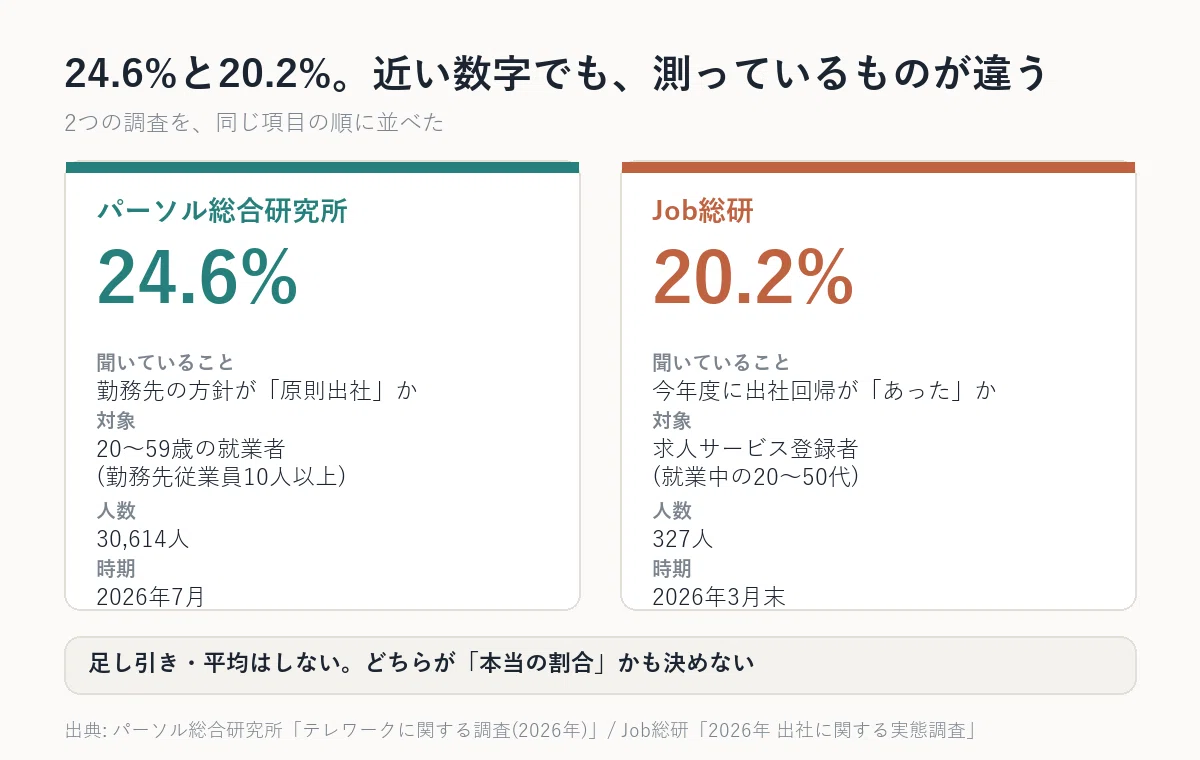
However, these two are not measuring the same thing. There are three differences.
The first is the number of people and the target audience.
Persol Research and Consulting surveyed 30,614 people, while Job Research surveyed 327. The number of people differs by about 100 times.
It also differs in that Job Research targets registered users of a job recruitment service.
The second is what is being asked.
Persol Research and Consulting asks, « Is your workplace policy mandatory office attendance? »
Job Research asks, « Was there a return to office attendance this fiscal year? »
One is about policy, and the other is about events that occurred this year.
For example, someone who has been working at a company with mandatory office attendance for a long time would be counted as « mandatory office attendance » in the Persol survey, but might not be included in the Job Research survey’s « return to office this fiscal year » category.
The third is the timing.
The Persol survey was in July 2026, and the Job Research survey was at the end of March 2026.
Therefore, these two numbers cannot be added or subtracted. We do not take an average either.
We also do not discuss which one is the « true percentage. »
All we can say is this:
In both surveys, which differ in how they ask questions and the number of people surveyed, the trend of returning to the office is occurring to an extent that cannot be dismissed as « only happening at a few companies. »
We applied two different rulers, and both showed movement. That is how we interpret it.
So far, these are the numbers from the office-attendance side.
Next, we will look at how much remote work remains from the opposite perspective.
Chapter 3: The telework implementation rate is 21.4%. It has been slowly declining since peaking in 2022.
The third point is the metric for implementation rates. This is the answer to the second question in the title.
According to a survey by Persol Research and Consulting, the telework implementation rate is 21.4%.
This is a 1.1 percentage point decrease from the same period last year.
https://rc.persol-group.co.jp/thinktank/data/telework-survey2026/
The institute analyzes that the telework implementation rate has been in a phase of gradual decline since peaking in 2022.
What I want to highlight is the word ‘gradual’.
Remote work did not disappear all at once after a certain year.
It is moving in a direction of decreasing little by little, but every year. That is the current situation.
Here, let’s place the figures from Chapter 1 side by side. In the same survey,
・Company policy is ‘mandatory office attendance’: 24.6%
・Telework implementation rate: 21.4%
Figures of similar magnitude are lined up.
However, these two are not figures that divide people based on the same question.
Therefore, I will not perform calculations like subtracting to find ‘what percentage remains.’ Please read each as a figure that captures the present from a different angle.
The overall picture has become visible with this.
That said, it is difficult to compare with your own company using only the overall figures. Next, I will break it down by industry and region.
Chapter 4: How much do the figures differ by industry and region?
These are also figures from the Persol Research and Consulting survey.
Industries with a high percentage of ‘mandatory office attendance’ (2026, full-time employees)
・Education and Learning Support: 30.0%
・Electricity, Gas, Heat Supply, and Water: 29.6%
・Finance and Insurance: 29.5%
All of these are higher than the overall figure of 24.6%.
Industry with the highest telework implementation rate
・Information and Communications: 55.7%
This is quite far from the overall 21.4%.
Regional telework implementation rates
・Kanto: 29.9%
・Tokyo: 35.5%
These figures are also higher than the overall 21.4%.
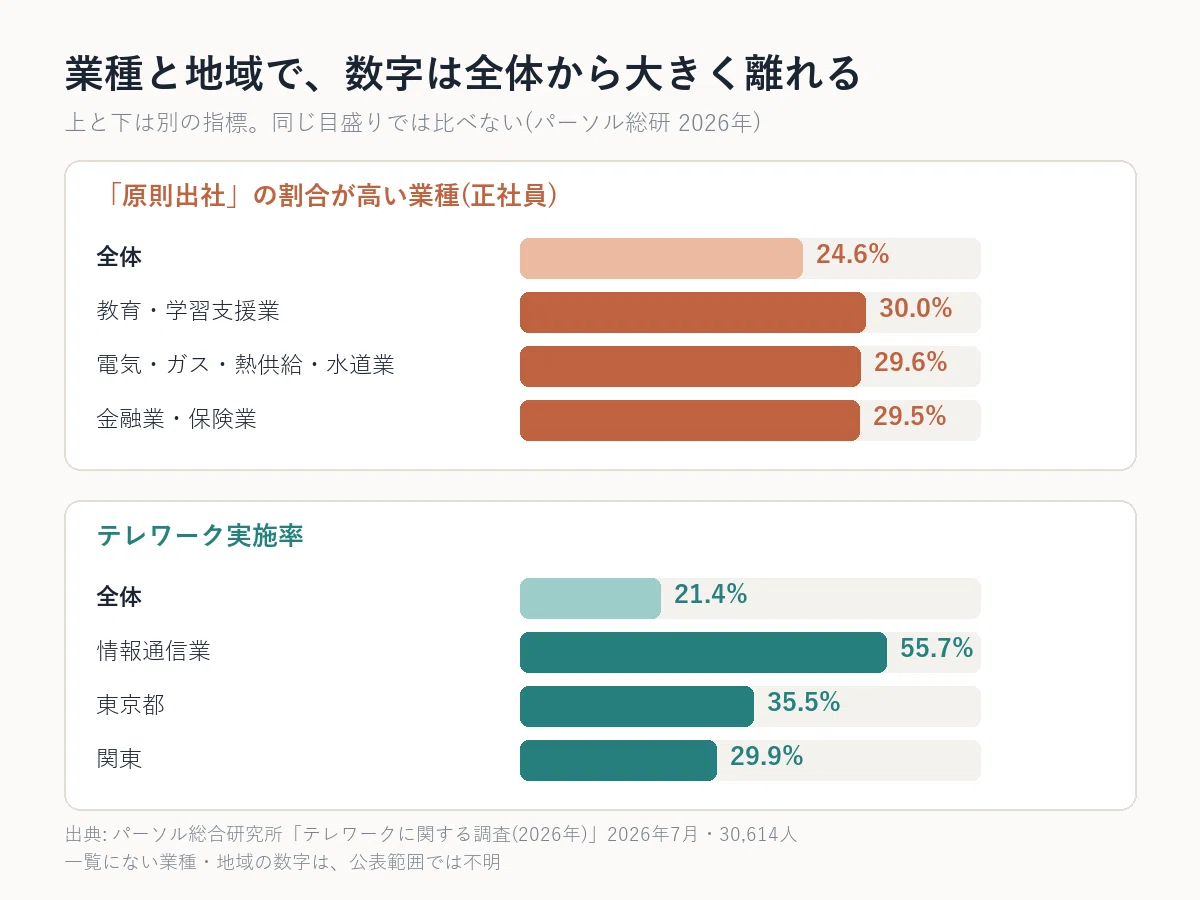
Depending on the industry and region, figures can deviate significantly from the overall average.
That is the main point I want to convey in this chapter.
However, please do not use these figures for comparisons like the following:
« Our company is strict because it is lower than the overall average. »
« Our company is lenient because it is higher than the overall average. »
Every industry has its own specific work circumstances. These figures are merely for seeing where one stands in society.
Applying this to your own company
Please stop for a moment and think about it.
Is your company’s industry included in the list above?
Is your company located in the Kanto region? Or in Tokyo?
For example, if your company is in the information and communications industry in Tokyo, comparing it to 55.7% or 35.5% might be more relevant than the overall 21.4%.
If it is a finance or insurance company, 29.5% serves as a benchmark for policy.
On the other hand, there must be people whose industry or region is not on the list.
To be honest, the figures for industries and regions other than those listed here are not known within the scope of what has been published.
In that case, please use the overall figures (24.6% for mandatory office attendance, 21.4% for remote work implementation rate) as a guide.
Chapter 5: Even if remote work remains, 48.8% do it one day a week or less. The current state of office attendance frequency
The fourth metric is frequency.
Even with the same ‘remote work available’ status, working from home four days a week versus once a month makes for a completely different lifestyle.
You can also check here where your assigned office attendance frequency stands relative to the rest of society.
Frequency of regular employees doing remote work (Persol Research and Consulting)
・Less than 1 day a week: 29.8%
・About 1 day a week: 19.0%
The combined ‘1 day a week or less’ for these two is 48.8% in 2026, compared to 49.4% in 2025.
32.7% of people also answered that their frequency has ‘decreased’ since 2025.
When you hear ‘21.4% remote work implementation rate,’ it sounds like all those people are working primarily from home.
But in reality, 48.8% of regular employees who do remote work do so for one day a week or less.
‘Remote work available’ and ‘primarily remote work’ are different things.
This might be the most overlooked figure in this article.
Fiscal year 2026 office attendance frequency (Job Research Institute)
・5 days a week: 48.3%
・4 days a week: 11.9%
・3 days a week: 10.1%
Here, I have only listed the options included in the survey. I have not filled in the percentages for the remaining options through calculation.
75.5% of respondents said their office attendance frequency would ‘increase,’ while 24.5% said it would ‘decrease.’
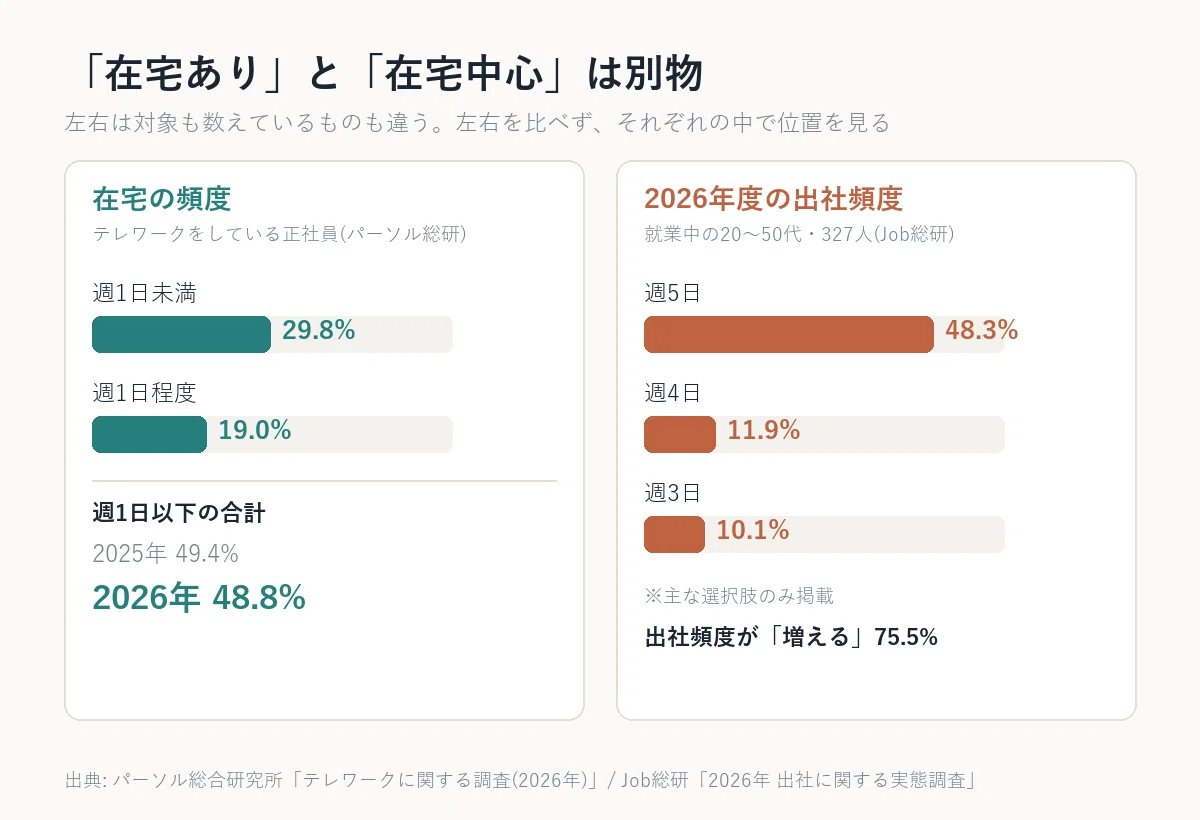
Please do not place these two frequencies side-by-side in the same table for comparison.
Persol Research and Consulting focuses on ‘the frequency of working from home for full-time employees who telework.’
Job Soken focuses on ‘the frequency of office attendance for registered users of job search services.’
The target audience and what is being measured are different. You should use them to see where you fit within each respective context.
Applying the number of days you were told
For example, if you were told you must ‘come to the office 3 days a week,’ in the Job Soken distribution, 10.1% come in 3 days, 11.9% come in 4 days, and 48.3% come in 5 days.
If you place Persol Research and Consulting’s ‘48.8% work from home 1 day or less’ alongside that, it might look different again.
Whether you feel it is strict or feel that remote work still remains is up to you.
That is something that can differ from person to person.
However, you should now be able to describe in your own words ‘where you stand in relation to society.’
With this, the answers to the two questions in the title have been provided.
Chapter 6: Reasons for increased office attendance, and the numbers for those who want to go to the office versus those who do not
Finally, I will briefly look at the ‘reasons’ for increased office attendance and how workers ‘perceive’ it using the numbers.
From here on, the focus is on the figures from Job Soken.
Reasons for increased office attendance (247 people who answered ‘increase’)
・Company policy has changed: 39.7%
・It is easier to proceed with face-to-face interaction: 18.2%
・New work has begun: 16.2%
The most common reason is company policy. It is that familiar scenario where a decision is made and a single notice is sent out.
Figures for those who believe office attendance is necessary
76.8% of people believe office attendance is necessary. The reasons (251 people) are:
・Easier to ask questions immediately: 61.4%
・Better communication than remote work: 52.6%
Even when looking at the ideal way of working, the total for the office-attendance group was 53.2%.
Figures for those who feel the burden of commuting and office attendance
On the other hand, 75.8% of people feel stress from commuting. As for the impact of this,
・Productivity drops: 51.1%
・Office attendance is a burden even before the commute: 48.6%
・Concentration decreases: 30.0%
62.8% of people also feel that commuting time is inefficient.
The ideal frequency for office attendance is 3 days a week for 20.8%, 2 days a week for 15.6%, and 1 day a week for 20.8%.
Figures for those who want to continue teleworking
In a survey by Persol Research and Consulting, 81.6% of teleworkers answered that they ‘want to continue’.
This is a figure asked of people who are currently teleworking, and does not represent the wishes of all workers.
I think office attendance is necessary. But commuting is tough.
The perception of those working is not leaning toward one side or the other.
Therefore, these figures cannot be used as evidence that ‘since many people prefer the office, we should follow suit,’ nor as evidence that ‘since many people feel stressed, the company is wrong.’
Both feelings exist within the same person. I think that is the closest way to interpret it.
You cannot change company policy on your own.
What you can change is how you structure your day after office attendance increases.
Chapter 7: Things to review in your life in advance when the number of office days increases
This is not about survey numbers, but about planning. Since this does not guarantee results, please pick only what seems to fit your situation.
The few weeks before office attendance begins are a good time to think about your arrangements.
Reassigning household chores and errands that you were handling on remote work days
Household chores and errands that you were finishing on remote work days will become gaps in your schedule as office days increase.
Write down ‘what, when, and who will do it on office days’ for each day of the week. If you live with others, talk about it once before it starts.
You can see on paper in advance where things will stop running smoothly.
When explaining the situation to someone, you can use the numbers applied in Chapters 4 and 5 as they are. Just telling them that ‘it seems this isn’t just happening at our company’ might change how the conversation is received.
Decide on one way to use your commuting time
In a survey by Job Soken, 18.3% of people answered that they could ‘make effective use’ of their commuting time.
I don’t think you need to force yourself to make effective use of it.
However, if you decide on one thing to do on the train on the way there, you will be less likely to be swayed by the returning commute time. It is, of course, also fine to use that time to rest.
Fixing what you do on the night before an office day
Clothes, belongings, and the next morning’s routine.
If you have lived a life centered on remote work for a long time, preparations for office days are surprisingly easy to overlook.
Decide what to do the night before and complete tasks in the same order every time. Just doing that will slightly reduce the morning rush.
Review how you spend your days working from home
The way you move through your day changes completely between office days and remote work days.
On remote work days, it is easy to find that you have barely left the house without realizing it.
I have summarized information on how to address lack of exercise and how to make time for walking outside on remote work days here.
https://note.com/nobu_se/n/nb376a955f236
If you are moving toward a work style that mixes office and remote work, please use this as an opportunity to review how you spend your remote work days.
Conclusion
Finally, let’s reorganize the numbers using four different yardsticks.
・Policy: Companies with a ‘mandatory office attendance’ policy: 24.6% (Persol Research and Consulting, 30,614 people, July 2026. Increased for two consecutive years)
・Events: Companies that ‘had’ a return to the office this fiscal year: 20.2% (Job Research, 327 people, end of March 2026)
・Implementation Rate: Telework implementation rate: 21.4% (Persol Research and Consulting. Down 1.1 percentage points from the same period last year, in a gradual decline phase since peaking in 2022)
・Frequency: Among full-time employees who telework, 48.8% do so one day a week or less (Persol Research and Consulting)
The reason I did not combine these numbers into one is that they are measuring different things.
From here on, it is your turn.
Try filling in the blanks in the following sentence for your own company.
‘We are in the ◯◯ industry, located in ◯◯, and work from home ◯ days a week. Looking at the numbers, we are close to ◯◯’
For example, if you are a person working at an information and communications company in Tokyo who works from home one day a week:
The benchmarks to compare against for implementation rates are 55.7% or 35.5%. However, in terms of frequency, you fall into the one day a week or less (48.8%) category.
In this way, your position can look different when you change the yardstick.
If you can say this one sentence, the vague feeling of ‘is it just my company?’ should have turned into something much more concrete.
When explaining it to someone else, you can start the conversation from here.
And there is only one thing to do today.
Choose one item from the review in Chapter 7 and write it into your schedule for the week before office attendance begins.
If you are unsure, starting with the allocation of housework and errands is fine.
Even if you cannot change the policy, you can decide on the arrangements in advance🗓️
Source (Verification date: October 15, 2026)
・Persol Research and Consulting Co., Ltd. « Survey on Telework (2026) » / Conducted July 10-13, 2026, 30,614 employed individuals aged 20-59 nationwide (at workplaces with 10 or more employees) (including 26,014 regular employees), announced August 27, 2026
https://rc.persol-group.co.jp/news/release-20260827-1000-1/
https://rc.persol-group.co.jp/thinktank/data/telework-survey2026/
・Job Research Institute « 2026 Survey on the Reality of Office Attendance » / Conducted March 25-30, 2026, 327 valid responses from employed individuals in their 20s to 50s registered with JobQ Town, published April 13, 2026
https://jobsoken.jp/info/20260413/
