


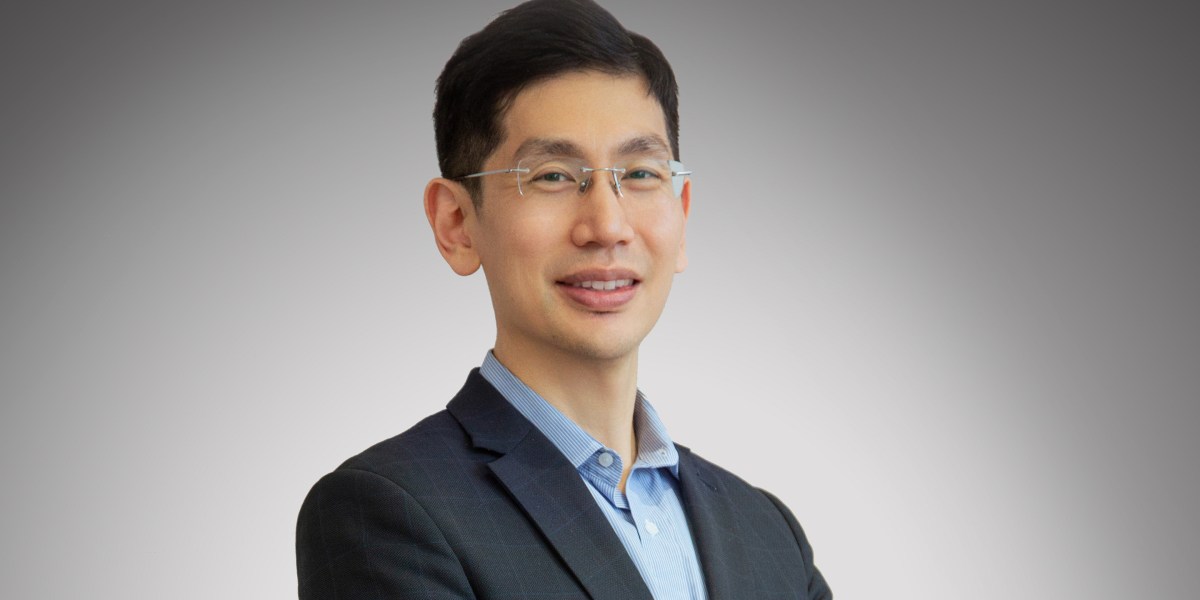
While the generative artificial intelligence boom is well into its third year at enterprises like personal-computer manufacturer Lenovo, Global Chief Information Officer Arthur Hu says he still believes that patience remains a virtue.
“There’s a bit longer grace period, because people recognize that we haven’t quite figured it out yet,” says Hu. “There’s more willingness to invest in Gen AI, even if the result will be rapid learning.”
Many studies align with Hu’s thinking. Enterprises are spending more on generative AI in 2026 than in the prior year. CEOs are far more optimistic about producing a return on investment, even as C-suite leaders acknowledge that the ROI time horizon for generative AI is longer than other technology applications.
Lenovo and other PC makers have seen mixed benefits from rising AI demand. AI PCs accounted for 31% of the total global PC market globally by the end of 2025, according to research firm Gartner. This new technology upgrade cycle gives Lenovo and other manufacturers a fresh opportunity to pitch new hardware. In Lenovo’s fiscal third-quarter earnings, reported last month, total revenue grew 18%, driven by strong demand for AI-related products. AI revenue increased by 72% from the prior year and now accounts for a third of Lenovo’s total business.
But as large companies like OpenAI, Amazon, and Alphabet build data centers, demand for memory chip production has surged, putting supply pressure on consumer electronics. Gartner has warned that rising component costs will dampen sales for PCs and smartphones in 2026.
Hu’s relationship with Lenovo began ahead of the 2008 financial crisis when he worked on projects for the company in China in his role as an associate principal at consulting giant McKinsey. He joined when the China-based PC maker dreamed to get a lot bigger and become a more international company.
More than two decades ago, Lenovo acquired IBM’s PC division to get a firmer grip on the global market. It later diversified into smartphones and infrastructure by acquiring Motorola Mobility from Google and IBM’s x86 server business. Hu joined Lenovo in 2009 as a corporate transformation leader, playing a key role in some of the integration after that dealmaking. He became CIO in 2016.
“Each of these cases represented significant steps in the company operating model, and therefore the types of systems and infrastructure support we needed to run the company,” Hu says of his evolving role, which coincided with advances in AI and machine learning.
Hu says that by the mid-2010s, Lenovo was following an AI playbook that could be replicated during the current generative AI boom. The company committed to using AI across the entire enterprise, starting with smaller use cases, and then expanding across product development, manufacturing, and other functions.
Even then, Hu says he had to address worker fears about job replacement. He tends to frame Lenovo’s AI push around three key themes. The first is that because Lenovo’s business is growing at double-digit rates, it can launch and leverage internal AI productivity tools that may slow down hiring, but aren’t intended to reduce total headcount. Second, Hu stresses that employees aren’t expected to deliver dramatic productivity gains within mere weeks or months. He understands change takes time.
And finally, Hu aims to lessen binary thinking that all work is either done by human or a machine. Reshuffling tasks, Hu says, isn’t so simple. When working with software engineers, Hu encourages them to not fixate on how much new code is being written by AI tools, but instead look at the fuller scope of their workloads.
“The rest of the time is understanding the legacy code base, talking to stakeholders, you have to understand the API, what does the business analyst say?” says Hu. “All this other stuff makes up the other 85% of the job.”
Across Lenovo today, internal AI tools that have been deployed include Microsoft Copilot, AI coding assistants for software engineers, and AI-assisted conversational support for customer service representatives. Broader tools like Copilot typically require little training, but Hu says more upskilling is needed when rolling out more specialized, function-specific tools.
And Hu concedes that even with the longer-lead time for generative AI, boards and executive committees have been putting more pressure on technologists to accelerate deployment and extract ROI. There is only so much patience, after all.
“That’s good and bad, it certainly pushes the pace,” says Hu. “People want to invest, but ultimately the economics have to work. Money isn’t free, as our CFO and finance community likes to remind us.”
John Kell
Send thoughts or suggestions to CIO Intelligence here.
NEWS PACKETS
Trump bans Anthropic and OpenAI swoops in. The messy fallout between Anthropic and the Pentagon continues, as the Trump administration ordered federal agencies and contractors that work with the military to halt business with the AI startup after it refused to lift some restrictions on how its technology could be used. Anthropic has already threatened to sue after being labeled a security risk and rival OpenAI on Friday swooped in and inked a deal with the Pentagon for its AI tools (and days later, amended the pact to tighten the language around using AI for surveillance). There’s also some spillover already underway for how the broader public is digesting these headlines as politics mixes with AI. Anthropic’s Claude overtook ChatGPT as the top downloaded U.S. app over the weekend.
OpenAI raises another $110 billion. Amazon, Nvidia, and SoftBank were among the large investors that funneled tens of billions apiece into OpenAI, fresh funding that values the AI startup at $730 billion. Amazon’s investment was of particular note as it was the first time the tech giant has put money into OpenAI (prior backer Microsoft sat out this round) and on Friday, issued a separate announcement that the AI startup would buy its AI chips and collaborate to develop customized models that would be available for Amazon developers. As the New York Times reports, the deal is yet another example of the AI industry’s circular financing, in which startups raise billions from tech giants and then use those funds to purchase compute power from the same investors.
OpenAI also vows to update safety protocols after shooting in Canada. The Wall Street Journal reports that OpenAI told Canadian officials that the AI company would reinforce its safety protocols after a fatal shooting in British Columbia in which the shooting suspect’s use of ChatGPT had been internally flagged months before the February 10 attack that left eight victims dead and dozens injured. OpenAI has acknowledged that the shooting suspect, Jesse Van Rootselaar, opened a second ChatGPT account after the first was banned in June. In the future, OpenAI said the criteria would be more flexible for referring accounts to law enforcement agencies and would help direct users in distress to support agencies, among other measures. The BBC reports that OpenAI CEO Sam Altman will meet this week with Canada’s AI Minister Evan Solomon to discuss the protocols.
Was Block “AI washing” when it announced deep job cuts? After Block, the payments company that operates Square and Cash App, last week disclosed it would cut its staff by 40% and said it could do so because AI was able to automate more work tasks, observers began to question this may be a classic case of “AI washing.” Major enterprises, especially in tech, have started to link layoffs to their AI efficiency investments and some executives, including JPMorgan Chase CEO Jamie Dimon, have warned that businesses and governments need to start preparing for the disruption. Still, Goldman Sachs has estimated that AI was responsible for only 5,000 to 10,000 monthly net job losses last year in the most exposed industries. EBay, which also announced job cuts last week, offered a more classic rationale: the e-commerce giant said it needed to shift resources to align with strategic priorities.
ADOPTION CURVE
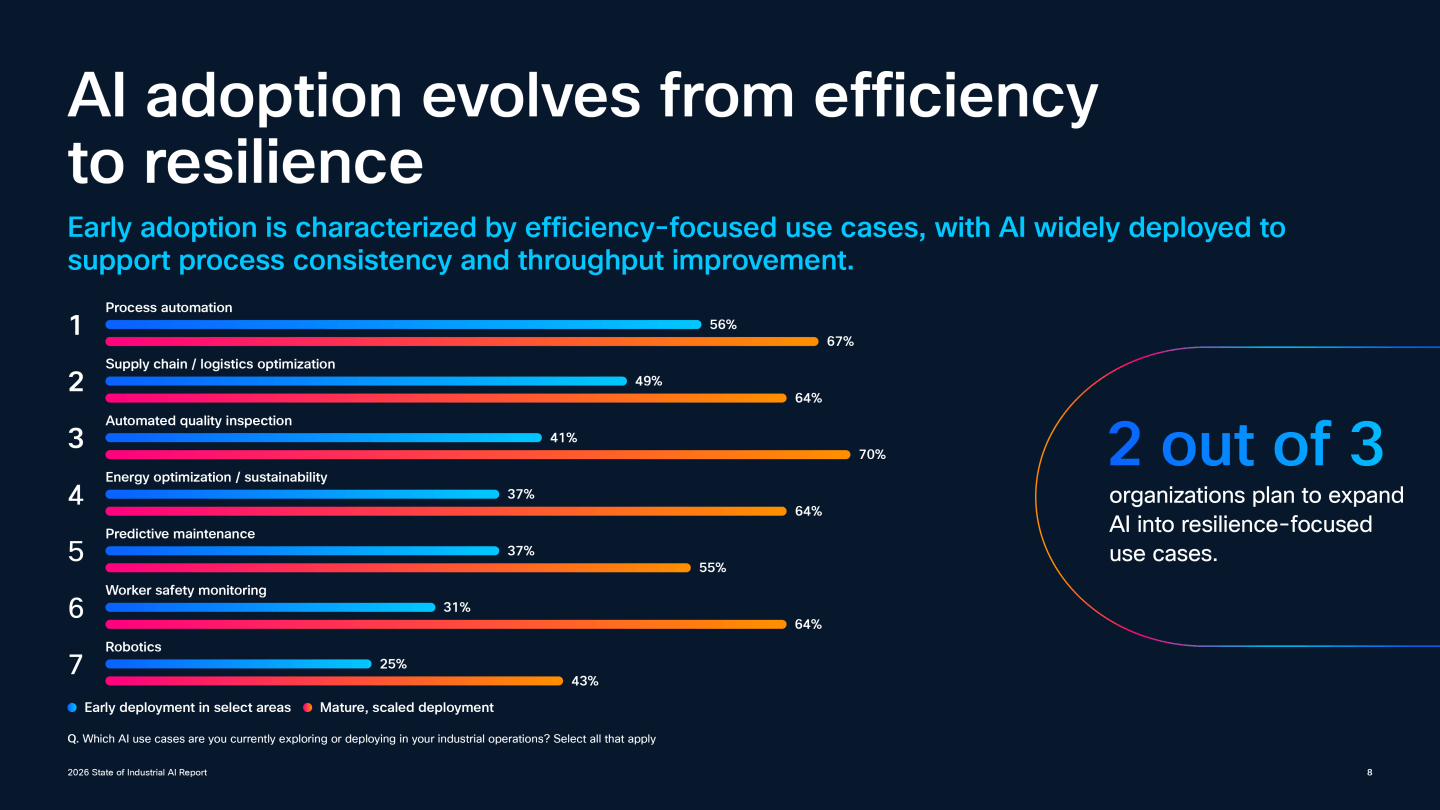
Industrial AI is booming, but more structure may still be needed. Industrial organizations are making real inroads on actively deploying AI at scale (61% report they have done so today), with some of the most mature applications focused on automated quality inspection (70%), worker safety monitoring and energy optimization (both at 61%), and predictive maintenance (55%).
The new survey of more than 1,000 technology leaders across 21 industrial sectors, backed by Cisco, also found that most industrial organizations would increase AI spending in 2026 (83%) and almost nine in ten projected they will see meaningful efficiency outcomes—boosting productivity, reducing costs, and improving security—within two years.
But even amid all that optimism, industrial leaders say the top barriers they still find themselves working through include cyber concerns (40%), technology integration challenges (36%), lack of skilled talent (34%), and budget constraints (25%).
Samuel Pasquier, Cisco’s industrial IoT networking product management lead, tells Fortune that he believes the skills gap is especially challenging. “The mindset of the network is like the power—you plug it in, it works,” says Pasquier. “Well, you need to be a little bit more organized and a little bit more structured.” To connect the dots, he says it is vital that companies cultivate stronger collaboration between plant-level operational teams and IT’s networking and security expertise.
Courtesy of Cisco
JOBS RADAR
Hiring:
– National Life Group is seeking a chief technology officer, based in Montpelier, Vermont. Posted salary range: $300K-$440K/year.
– Saval Foodservice is seeking a chief digital officer, based in the Washington-Baltimore Metro area. Posted salary: $200K/year.
– Transdev North America is seeking a CIO, based in Lombard, Illinois. Posted salary range: $290K-$325K/year.
– Harbor Health Services is seeking a CIO, based in Boston. Posted salary range: $186.2K-$291.2K/year.
Hired:
– Heineken has appointed Romain Apert as chief digital and technology officer and a member of the Dutch brewer’s executive team, effective May 15. Apert joins Heineken from Mars, where he served as CIO of the food giant’s petcare business. He worked at Mars for more than two decades and held various CIO titles since 2012. Apert succeeds Ronald den Elzen, who last year said he would depart to pursue a new career.
– Unilever promoted Reema Jain to serve as CIO, less than a year after she joined the consumer goods giant as global VP of digital technology. Prior to joining Unilever in May 2025, Jain served as chief information and digital officer at motorcycle and scooter maker Hero MotoCorp, chief digital officer at Indian telecommunications company Vodafone Idea, and held technology leadership roles at Unilever and GE.
– Hormel Foods announced the appointment of Donald Monk as CTO, effective March 23, in a newly created role. Monk will serve as the food maker’s senior-most technology leader as it prioritizes modernization of those platforms. Previously, Monk spent more than three decades at food giant General Mills, where he served as CIO.
– Thor Industries promoted Ryan Biren to the role of CIO, a newly created executive office position at the recreational vehicles manufacturer, overseeing IT, data, analytics, and the digital platform strategy. Biren initially joined Thor in February 2024 as VP of corporate development. He also previously served as SVP at RV retailer Camping World.
– Diebold Nixdorf announced the appointment of Andy Zosel as chief product and technology officer, a newly created role to unify the ATM manufacturer’s product management, engineering, R&D, software and hardware innovation teams. Zosel previously served as SVP of intelligent automation for printer and barcode scanner maker Zebra Technologies.
– Victory Capital has appointed Molly Weiss as CTO and head of digital innovation, where she will lead the asset-management company’s technology infrastructure, AI framework, and data and analytics platform. Previously, Weiss served as group president of wealth platforms at software provider Envestnet Financial Technology.
– Digital Turbine named Ben John as CTO, where he will oversee global engineering, AI development, and product architecture. He joins the advertising software provider after most recently serving as VP of engineering at Microsoft AI Copilot. Previously, he has served as CTO and co-founder of Xandr, an ad-tech company that Microsoft acquired in 2022.
