


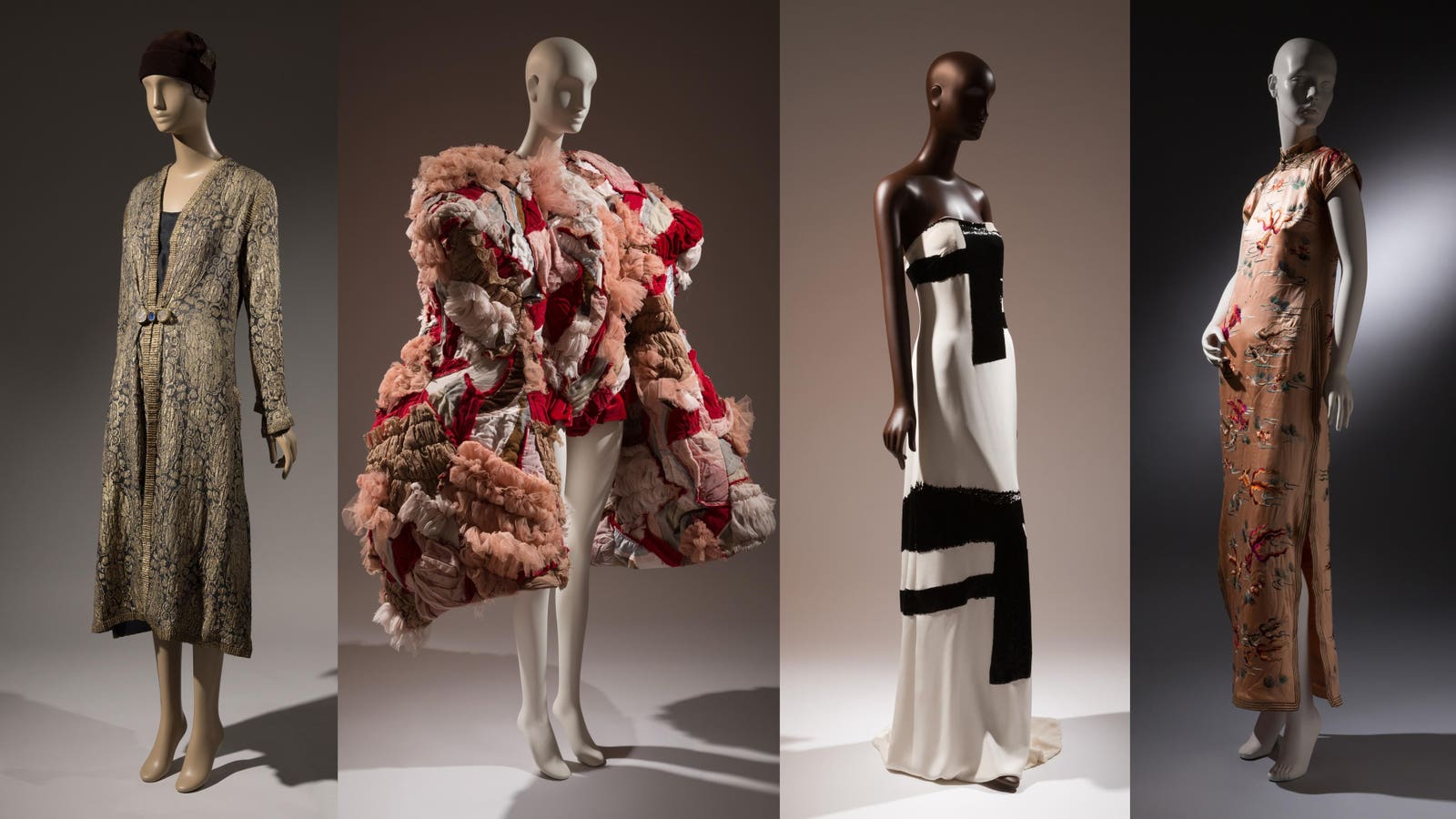
A selection of designs, curated by Dr. Elizabeth Way, from her exhibition, Art X Fashion.
Courtesy of The Museum at FIT
The only dedicated fashion museum in New York City, The Museum at FIT, has opened a fascinating new exhibition, Art X Fashion. Curated by Dr. Elizabeth Way, the show reinforces one of the museum’s overarching missions; to advance the way culture thinks about apparel. It is a conversation of sorts, one made up of questions, but it leaves the answering part up to its audience.
“I don’t think all fashion is art,” Dr. Elizabeth Way said to me when we met to discuss her latest project. “We could go back all the way back to the Renaissance and see a very specific hierarchy that people have created in terms of ‘high art’, which would be painting, sculpture, sometimes architecture. Then there’s the decorative arts, and often these are more associated with women’s work, which I think is an important thing to realize. But fashion is also worn on the body, and again, coming out of this Renaissance tradition, there was this idea that art is spiritual and intellectual and things associated with the body were lesser. Fashion is inextricably tied to the body, but it’s also a very everyday experience for us all, to get dressed, and I think perhaps people think of looking at an expensive painting or a sculpture as a more rarefied experience. I think there’s a lot of different perspectives on why fashion has been separated from the world of art, and of course, the commerciality of it all. I would argue that the art world is very, very commercial, but certainly not as extensively as the fashion industry.”
Tavares Strachan for B.A.S.E.C., changeant fabric bomber jacket with custom flight patches, 2020, United States. Gift of Janelle Reiring.
Courtesy of The Museum at FIT
There are times and places when apparel transcends its commercial and utilitarian purposes, when it approaches that mythical ivory tower, and I asked the curator where she thought than line might be drawn.
“I think an important aspect of what we appreciate about art is that it evokes this emotional response,” Dr. Way said, “but I also think it’s important to think about the maker and what the maker is trying to convey. If they’re trying to express their inner perspectives, commentary about culture or art, or if they’re doing something innovative in terms of the creative design, when that happens I think it aligns fashion much closer to art. One definition of art is that it does not have a function beyond this visual and spiritual interaction. So I think when fashion moves more towards that less functional realm, people have an easier time understanding it as art.”
The Meeting of Worlds
There are designers and designs which are, to anyone who sees them, objectively more than just function or even simply luxury. If we think about Iris von Herpen and all her coiling, twining organic shapes, we can look past their unfunctional nature and instead see that the beauty of movement has its own purpose. Historically there have been many designers whose work challenged societal norms and expectations, and the interactions between designers and artists, as well as the instances where those two roles are the same, is one of the ideas that this exhibition explores.
Salvador Dalí and Baccarat for Elsa Schiaparelli, Le Roy Soleil perfume bottle, glass and aluminum, 1946, France.
Courtesy of The Museum at FIT
“Schiaparelli really looked at her practice as an art practice,” Dr. Way explained, “and she was really interested in what clothing could say beyond just the function, or the idea of being a stylish woman. She really took a lot of chances with her fashion and collaborated with artists, but this time period, in the 1930s, in some ways it’s been recognized, and in some ways criticized, as this total fantasy. This escapism, an almost denial of what was going on in Europe and with the impending forces. But I think that when you have all of these political cultural machinations that are out of the control of an individual person or designer, escapism is one reaction to it. I think that,looking back, we can see the anxiety that was like swirling around in society and how it was coming out.”
“You can see many examples in art,” the curator continued, “particularly surrealist art, the ways in which people are turning inward for answers, looking at the subconscious. That played out in fashion, especially with designers like Schiaparelli, and though I think it’s hard to make comparisons between early 20th century fashion and today, I certainly think this idea of escapism of more traditional ideas of prettiness might be a reaction to the instability of the world today.”
Paul Poiret, silk brocade evening coat with hat by Madeleine Panizon for Paul Poiret, circa 1925 France.
Courtesy of The Museum at FIT
Elsa Schiaparelli was obviously not the first couturière to play with the line between fine art and apparel, nor was she the first to create work that felt like part of an artistic movement more than a season or collection.
“We always think of the 1920s as this super modern period,” Dr. Way said, “but we have this streak of modernity that is making itself known in fine art that fashion designers are picking up. Designers like Paul Poiret were interested in these new ideas, and bringing them into fashion, changing what has been accepted as ‘women’s fashion’ throughout the 19th century, and making it modern and more in line with art. Poiret was a really great example of someone who worked with artists, like Raoul Dufy. We have some of his designs for these really bold textiles that were inspired by the Fauvists, and really connect it to an artistic lifestyle. He was really well known for his interest in Orientalism, which had a lot of connections to the dance scene in Europe and Paris at the time with Diaghilev and the Ballets Russes. He was bringing all of these things together through his fashion design, through interior design, but also through these parties that he would throw. So, it was about living this artistic lifestyle, and that was something that was pretty new. The idea that these ideas could affect more than just this very small, artistic bohemian circle. In the beginning of the 20th century, we see this opening up and more, and more people engaging with this idea of this artistic life.”
Sonia Delaunay, watercolor of four women in patterned dresses, 1925, France.
Courtesy of The Museum at FIT
Deconstruction and Recreation
Art states opinions, it challenges or celebrates, and one of its most important societal roles is to encourage the viewer to examine their thoughts or feelings. When I learned that the exhibition was to include pieces by one of my favorite historic Ukrainian designers, Sonia Delaunay, I knew that I had to ask the curator about the pieces she chose and how they contribute to the larger questions this exhibition poses.
“We’re very lucky at the Museum of FIT to be able to include pieces by Sonia Delaunay,” Dr. Way told me. “We have textile designs that she created, in-process works, and these hand-painted prints of her work. Delaunay is foremost thought of as an artist, but she ran a fashion house, she designed textiles, it was an integrated part of her practice for most of her creative life. She wasn’t a person who drew distinctions between fashion and commerciality and her paintings, and of course she had a really important impact on sense of color. She had these ideas about color and vibration, and she was very much in touch with what was important and innovative in fine art and painting, but she carried that same enthusiasm into her fashion and textile design. In that way I think that she was such a holistic creator, and one of the best examples of how fashion can be art, especially since those lines are very blurry.”
Wales Bonner X Kerry James Marshall, cotton t-shirt reproducing Lost Boys: AKA Black Sonny (1993) by Kerry James Marshall, spring 2023, United Kingdom.
Courtesy of The Museum at FIT
Grace Wales Bonner is another important designer whose work is included in Art X Fashion, and while I was looking at the collection as a whole I kept thinking about how much the pieces included felt like a dialogue across time.
“She’s an incredibly intellectual and thoughtful designer,” Dr. Way said about Bonner, “and the piece that I have in the exhibition is part of this section that looks at the ways in which famous artworks are reproduced on apparel. The vast majority of these are actually pop art, so we have Andy Warhol’s Marilyn Monroe on a Versace jacket, or a Lichtenstein print on a Moschino jacket. We see the ways in which reproducing art can be humorous, it’s engaging, it gives the audience something that they can latch on to, but we also see how we can use these collaborations for social good. We have Keith Haring’s designs on a t-shirt, and the ways that he used that talked very specifically about using that work to fund his art. He was a working artist, he could work in a lot of different mediums, but of course it was important to support himself. Then Grace Wells Bonner partnered with Kerry James Marshall, and these are both creatives who think deeply about the Black experience, and by coming together reproducing one of his paintings on a t-shirt in her collection, they’re using that money to raise funds to support a charity that helps formerly incarcerated people. So we see how, when art and fashion come together, it can be put to different means and different uses. In this particular one, it’s the ethos of the designer and the ethos of the artist going towards a cause that is important to both of their creative practices.”
Versace, cotton and silk jacket referencing Marilyn Monroe (1967) by Andy Warhol, 1991, Italy.
Courtesy of The Museum at FIT
This made me think about how the licensing agreements, or the various tiers of lower priced lines, all under the Big Name Brand umbrella, are often what supports haute couture, or the ‘Runway Only’ designs which are most likely to make a big splash on social media each Fashion Week cycle begins to move across the globe. I asked if there were other examples of work in the exhibition that showed how artists used commercial work to fund more experimental projects.
“Absolutely,” said Dr. Way, when I asked if this comparison felt fair. ”Some of the other pieces that we have in the show are these fashion drawings we borrowed from an artist named Boris Lorry, he was a Holocaust survivor and a multimedia artist who worked in a lot of different mediums, from portraiture to mixed media sculpture. But he also created fashion illustrations for magazines as a way to support himself. He also designed textiles that were put into production. So we think about artists in the same way that we can think of the designer, in a very singular way, but these are creative people who are working in a lot of different mediums, and very importantly, have to support themselves.”
Henriette Nigrin for Fortuny, pleated silk “Delphos” dress, circa 1925, Italy. Gift of Mrs. Varney T. Elliot and Mrs. Rosemary T. Franciscus.
Courtesy of The Museum at FIT
Intention and Expression
There have always been Black designers whose work contributed greatly to fashion’s discourse, and whose work, because of the work of academics like Dr. Way, is being better documented, remembered and studied than it was in decades past. Scott Barrie, Fabrice and Eric Gaskins all have work in Art X Fashion, and I wanted to know more about their pieces. How and why they were chosen, how art and art education informed the designs, and how these specific pieces were vital in making the implied argument that apparel could be art so compelling.
“The Scott Barrie piece in the exhibition is a beautiful example of how art education has impacted fashion designers,” Dr. Way told me. “He talked very specifically about being at the Philadelphia Art Museum School, about his life drawing classes and the way that helped him understand the body. And in his very body conscious pieces,, it looks like a very simple dress, but it’s the body that makes it come alive. You can see that art education there.”
WilliWear, printed cotton shirt and shorts with knit top, spring 1985, United States. Gift of WilliWear, Ltd.
Courtesy of The Museum at FIT
“Whereas Fabrice,” Dr. Way continued, “he was a painter, and he actually went from being a fine artist to applying those skills to fashion. His first fashion pieces were hand painted, and it was actually a sister who inspired him to transfer those motifs into beading, which he turned into an art form. I think when you have designers who are designing the textiles and the silhouettes, you see them come together in a really beautiful way. You can see that also with Ralph Rucci, and Zandra Rhodes, who are two other painters-turned-fashion-designers in the exhibition.”
The absolutely beautiful beadwork by Gaskins, its exquisite trompe-l’oeil effect, I had to ask about it because the work is such a perfect example of what can be achieved on the human form.
Eric Gaskins, silk and glass bead dress, 2014, United States. Gift of Eric Gaskins.
Courtesy of The Museum at FIT
“The Eric Gaskins is a really, really beautiful piece,” Dr. Way said to me with a giant smile, “and an example of the ways in which fashion designers are inspired by art. I have some really fun, cool pieces in the exhibition that are really just reproductions of famous artworks. But when fashion designers really bring that high level of skill, taste and proportion to fashion pieces, we see this interaction. We see the creativity of both the inspirations, and in this case it’s Franz Klein’s paintings. Eric Gaskins is really a couturier. All of the motif is hand beaded, and he even breaks down the beads into these tiny pieces in some places, which really recreates the brush strokes. That’s in the same section as YSL’s Mondrian dress, which I think is a really popular example, but it’s not just a recreation of that motif. It’s the way that he fit this two-dimensional composition onto a three-dimensional body that really shows his pattern-cutting expertise, and that’s when we see the expertise and the talent of the designer coming together with the inspiration that is the art.”
Expanding Vision Beyond Any Singular Realm
That YSL Mondrian dress Dr. Way mentioned, it’s super famous, so much so that I’d bet that even people who don’t think of themselves as into fashion would recognize it. But even if it’s culturally ubiquitous, I wasn’t sure how well people understood that the design was literally revolutionary when Yves created it in 1965, the same year that Diana Vreeland coined the term ‘youthquake’. I asked if she could help break the story down and help my Lovely Readers understand why the trapeze dress was bigger than just a fad.
« Mondrian » dress, sleeveless chemise in ivory wool jersey with pieced geometric design of black stripes and single red « color block » at left shoulder
Courtesy of MFIT
“People have written exclusively about YSL, and their connection to Mondrian,” Dr. Way told me. “Yves Saint Laurent was not the first person to recreate these paintings on clothing, but the way that he was able to break down this very flat, very square motif, and put it on a three-dimensional body, it was such a young idea for couture, but it still had all of those old-school couture techniques. You know, taking out the curves in the seams is really difficult, I worked very briefly as a pattern maker, it’s a really difficult task. He was making a real argument that fashion should be modern, it should be young, it should be playful, and it can still have the amazing craftsmanship that people value about haute couture. And what’s so interesting is that Piet Mondrian was actually painting in the 1930s. He wasn’t working at this youthquake a moment, but YSL was able to look back at the history of art and see these motifs that were still important ideas in the 1960s. He was an avid art collector, YSL really loved and understood fine art, and he saw what those ideas could bring to fashion.”
(As a brief aside- if anyone wants to read more about this dress and the impact Yves Saint Laurent had on both the house of Christian Dior and haute couture more generally, these are all excellent books: Art and Fashion: The Impact of Art on Fashion and Fashion on Art by Alice Mackrell, BT Batsford Ltd, 2005; YSL: The Impossible Collection byLaurence Benaïm, Assouline, 2020; and Mondrian’s Dress: Yves Saint Laurent, Piet Mondrian, and Pop Art by Nancy J. Troy and Ann Marguerite Tartsinis, Rizzoli, 2023.)
Moschino Cheap and Chic, acetate and rayon jacket referencing Girl with Hair Ribbon (1965) by Roy Lichtenstein, spring 1991, Italy. Gift of Michelle Perr.
Courtesy of The Museum at FIT
Looking again at the Iris van Herpen, and at the Franco Moschino, both of whom are designers whose work always feels like art to this writer, I wanted to know if the museum’s curator of costume and accessories felt like ‘wearable’ impacted the way the general public decided whether or not a garment could count as a piece of art.
“I think the definition of wearable varies from person to person,” Dr. Way said to me, “and I think it really goes back to ideas and feelings. I think all fashion designers want to evoke some emotion in their clothes, whether it’s something tactile, whether it’s comfort, whether it’s sexiness, these are important factors that help a person fashion their own identity. But when the clothes are really saying something, it’s saying something beyond the wearer. It’s less about the relationship with the wearer, and what that they protect personally, and what the designer is putting forth as their creative ideas. I think that’s when we see fashion align with art, when it’s larger than life, when it’s unexpected on a human form, I think those are aspects that lend an artistic ethos to fashion design.”
Comme des Garçons, patchwork bodysuit with extended and exaggerated sleeves, spring 2018, Japan.
Courtesy of The Museum at FIT
Weaving Art Into Design
It is always impossible for me to pick a favorite piece from an exhibition as excellent as this one, I tend to have lots of favorite designer pieces, but the Comme des Garçons ensemble included in Art X Fashion was a strong contender. I asked the curator if any of the pieces were especially meaningful to her.
“One of my favorite pieces is a new acquisition that we got for the collection specifically for this show,” Dr. Way explained. “It’s by a designer named Josh Tafoya, and he’s a New York designer, trained at Parsons, and over the pandemic he left New York, like many of us did. He went back to his hometown,Taos, and he picked up weaving and in this very short period of time he has become an art gallery level weaver in the Rio Grande weaving style. His family has a long-standing tradition and history of Rio Grande weaving, but he also takes that weaving and brings it back into fashion. I think it’s a really important meeting point of fashion and what art museums have traditionally found to be exhibition worthy. Textile art has been in museums for a very, very long time, but fashion has a much shorter history in museums, but he brings these two art forms together in a really outsized, attention-grabbing way. You have the detail of the weaving, which is so intricate and beautiful, and then he designs apparel with it, and I really like the relationships that he’s creating. Textiles and fashion are obviously very connected, but in some ways, especially when considered as art, they are very far apart.”
Josh Tafoya, Genizaro collection hand woven wool coat, spring 2025, United States.
Courtesy of The Museum at FIT
People today seem to be more interested in making than they were in decades past. It’s probably partly related to the pandemic, when lots of us picked up new hobbies, and it’s probably connected to the recent prevalence of artificial intelligence. What I was hearing, the conversations that I could imagine exhibition visitors having after looking at this extensive range of fashion that could very easily be seen as fine art, it reminded me of what an incredible resource the Museum at FIT was, both to the students it serves and to the larger fashion community in New York City.
Admission is always free for any of the exhibitions the Museum at FIT puts on, one of many reasons the only museum in NYC completely dedicated to fashion is such a treasure. But I was curious what the curator felt that Art X Fashion offered to the students and to people like me, who are completely obsessed with fashion design.
Carolyne Roehm, metallic tulle evening dress with matching shoes by Manolo Blahnik, 1990. United States. Gift of Carolyne Roehm.
Courtesy of The Museum at FIT
“We are a fashion and creative arts college,” Dr. Elizabeth Way said, “and many students are taking basic art history, thinking about the ways in which the history of art has influenced art itself, and hopefully influencing their creative practice. So the beginning of the exhibition is actually a timeline, and I don’t want to think about how fashion was inspired by art, but how fashion and art both came out of a creative zeitgeist. We have these art movements we look at, from Rococo to Post-Modernism, and I have different examples of fine art reproductions and fashion. It’s about these ideas swirling around, and how they can be executed and expressed in different mediums. I hope it is very helpful for students, but as always, I hope that the designers that we put on display are inspiring, that they learn more about them, and expose themselves to more and more images that can feed into their own kind of catalog of design inspiration.”
Art X Fashion, curated by Dr. Elizabeth Way for the Museum at FIT, will be open from February 18, 2026 through April 19, 2026.
Follow me for more stories about the important role fashion design plays in our cultural conversations, and for interviews with more brilliant people whose work elevates the conversations in and around what we wear.
