


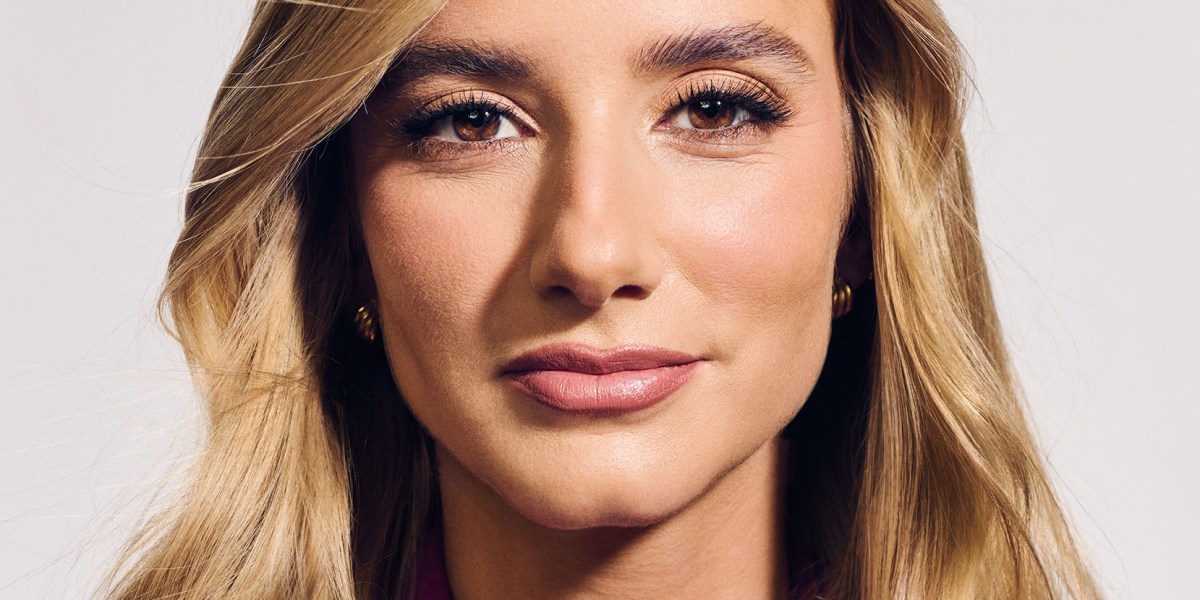
It’s Election Night 2026. Luana Lopes Lara has been preparing for this evening for at least three years. Fresh off a plane from the buttoned-up Futures Industry Association’s expo in Chicago, the 30-year-old on-paper billionaire heads straight to the downtown Manhattan offices of Kalshi, the $40 billion prediction market startup she cofounded that promises to change how we interact with the financial system and understand our future.
“Are the odds going to be everywhere? Are we going to have the best product?” Lopes Lara asks.
Her staff are waiting in a war room ready to order pizza, screens lighting up with constantly changing blue-and-red odds, a second-by-second accounting of all the trades on the Kalshi app. Will Democrats take the Senate? Kalshi’s market on that yes-or-no question is judging the odds at 76% yes, with more than $338 million collectively bet on the outcome. The Texas governor’s race market flips for underdog Democrat Gina Hinojosa, and someone screams—Lopes Lara and her team all huddle around to see what’s happened.
Kalshi and its competitor Polymarket provide an experience somewhere between betting on DraftKings and browsing X. Users put money down on any number of questions—Will the Buffalo Bills beat the Minnesota Vikings? Will Taylor Swift be seen with ex-friend Blake Lively by the end of the year? Will the price of Bitcoin increase in the next 15 minutes?— and receive a payout (or lose their money) when the answer is revealed, if they don’t cash out sooner. The technical term for these bets is an “event contract,” a form of trading regulated by the federal government’s Commodity Futures Trading Commission (CFTC). Users who take a bold stance—say, calling the 2028 nominee a year-and-a-half before the Democratic convention—can earn big.
But Kalshi has become more than a place to make a wager. Its prices can serve as real-time, crowdsourced odds on what comes next. “Having an unbiased source of information and data about what’s going to happen in the future is more needed now than ever before,” she said in mid-October. “You get (that) because you’re incentivizing people to be right.”
Polymarket set off the craze for prediction markets by correctly calling Donald Trump’s win in the 2024 election. But in the past year, Kalshi has pulled ahead, claiming more than 70% of U.S. trading volume with more than $1 trillion expected to be traded by 30 million users this year. Its valuation has soared from $2 billion to $40 billion in 18 months, with another jump likely ahead. Until recently, it counted Donald Trump Jr. as an advisor, and its two founders, with 12% stakes valued at $2.6 billion each, are now among the world’s youngest self-made billionaires.
Kalshi had billed 2026 as the first true “prediction market election,” and Kalshi traders put more than $2.5 billion on races. Lopes Lara, an MIT math whiz, explains that when prediction markets don’t forecast the right outcome, they’re not wrong, per se. “That’s how probabilities work,” she says. Still, on Election Night, the pressure was on for Kalshi’s predictions to be right.
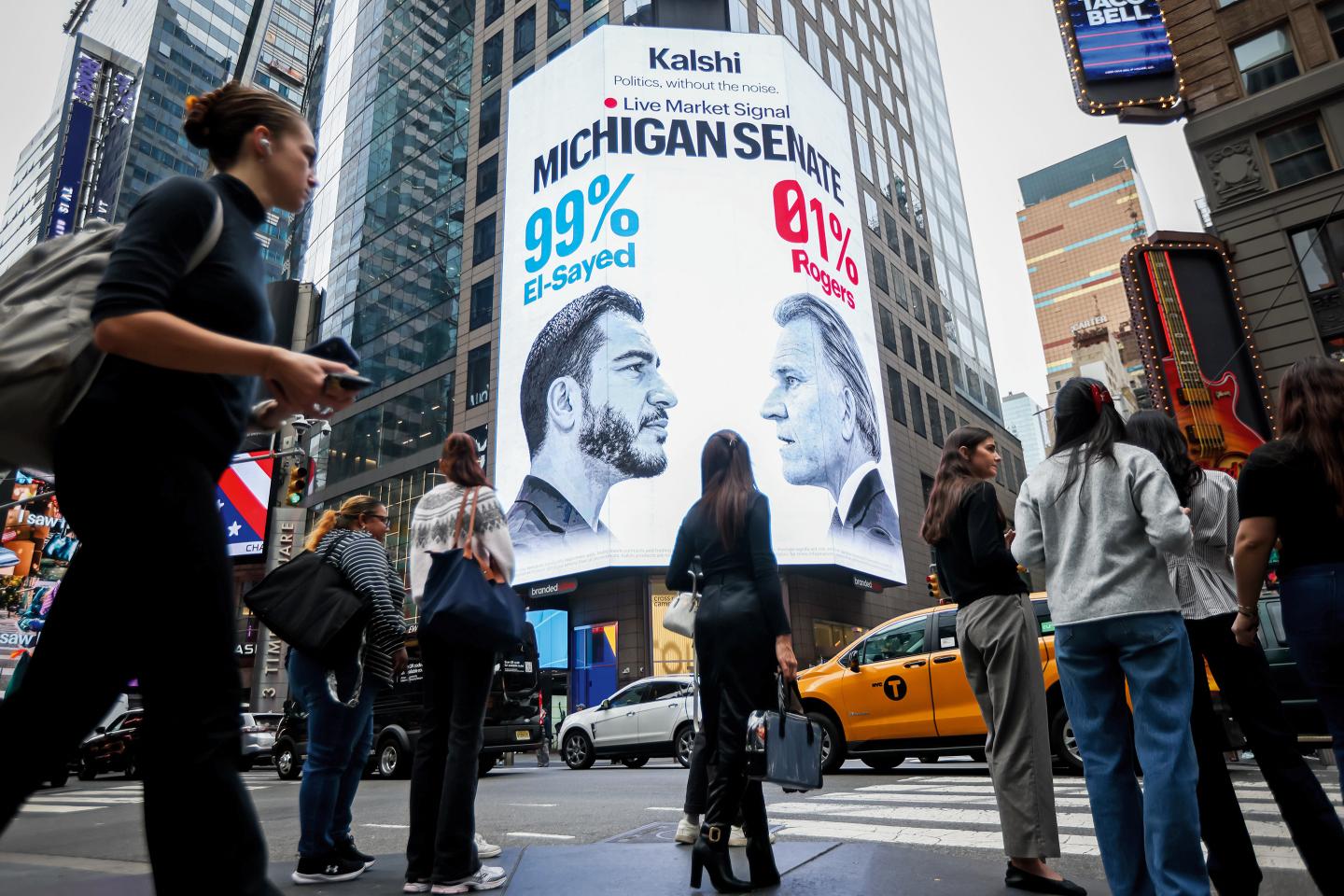
the Michigan Senate race.
Michael Nagle—Getty Images/Bloomberg
By Wednesday morning, Democrats had clinched the Senate, and Kalshi’s markets had predicted 98% of the called races correctly. (They had missed Hinojosa’s unexpected win.) Kalshi’s top election trader pocketed $1.1 million. Lopes Lara had gotten four hours of sleep. “We had our own tsunami of people actually saying good things about us,” she said, alluding to the Democrats’ blue wave.
Positive press for Kalshi can be hard to come by. Critics say it’s normalizing gambling among teenagers, and it’s facing legal challenges in at least 23 states over whether trading on sports—which accounts for the majority of Kalshi’s revenue—should be subject to state gambling laws. Part of the company’s answer has been to court institutional investors, a push that would grow its business while making it less dependent on the retail traders at the center of many consumer-protection concerns.
The day after the midterms, Lopes Lara was headed to ground zero of the debate: Washington, D.C., where the Supreme Court and the incoming Democratic-led Congress could decide whether the booming startup continues its meteoric climb or faces a regulatory reckoning that sends it crashing back to earth.
Prediction markets are a decades-old idea, Lopes Lara and her cofounder, Kalshi CEO Tarek Mansour, say. They cite the mid-20th-century work of Nobel-winning economist Friedrich Hayek, whose theory that markets gather dispersed knowledge inspired Mansour to build “an information market that asks simple questions about the future and (applies) financial market dynamics to those questions.”
Their vision to financialize almost any point of view started when Lopes Lara and Mansour met as students at MIT. He was intrigued by how she sat in the front row at every lecture. At MIT, studying hard wasn’t uncommon, but her consistency stood out. She was in the student center until 3 or 4 a.m. every night, he remembers.
She was unusual in other ways, too. Lopes Lara had trained at the harsh Bolshoi ballet academy in Brazil, the only international offshoot of the intense Russian dance school. Academics started at 7 a.m. and ballet lasted until 9 p.m. At times, lit cigarettes were reportedly held under students’ legs to keep them in the air. After graduating, Lopes Lara danced professionally for nine months in Austria. She got into Harvard, MIT, Stanford, and Yale, and chose the school with the least connection to the arts, the one that would force her to “just focus” on math.
Lopes Lara and Mansour—a couple at the time—interned together in quant finance and decided to found a company in 2018. In 2019 they got accepted to startup accelerator Y Combinator and spent the next two years fighting an uphill battle for federal approval of Kalshi. (Eventually, they broke up. “Being next to someone the whole day, working and dating—it just died out,” Lopes Lara says.) In 2020 the CFTC approved Kalshi as a designated contract market, offering event contracts.
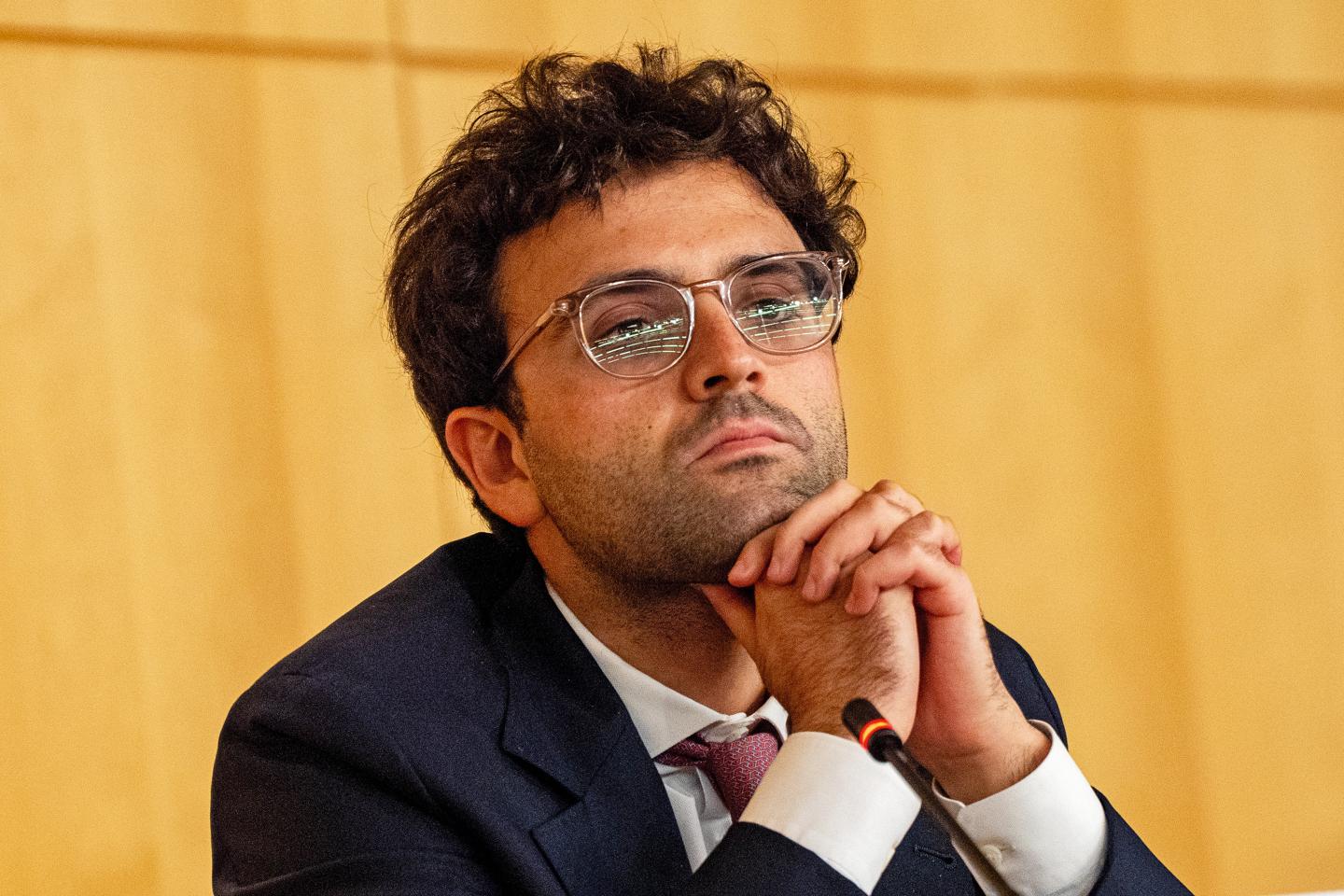
Kent Nishimura—Getty Images/Bloomberg
Y Combinator served as a forcing function in another way: It requires every startup to name a CEO. The choice for Kalshi came down partly to logistical factors. Mansour was born in California before growing up in Lebanon. As an American CEO, he could hire Lopes Lara, a Brazilian citizen, and sponsor her visa. She thought his English was better than hers, too.
The founders decided to split duties: CEO Mansour would focus on “everything external,” while COO Lopes Lara handled “everything internal.” “External” at Kalshi covers a lot: fighting for the right for the industry to exist and to prevent $40 billion in value from evaporating overnight. But “internal” means Lopes Lara oversees almost every function at the company—product, markets, engineering, and marketing. Today, Kalshi’s more than 200 employees mostly report up to her. Until a few months ago, Lopes Lara interviewed every new hire herself. She’s an “incredibly good operator” with a commitment to constant self-improvement, Mansour says; he’s described himself as “incapable of managing.” She’s casual at the office but arrives to public appearances photo-ready. When Mansour spoke at the Economic Club of New York in October, the event started late because he had to buy a new collared shirt after arriving unprepared for the dress code.
But painting Lopes Lara as a polished No. 2 would sell her short. As Kalshi has grown, Lopes Lara has taken on more public-facing responsibility. While Mansour can be prickly when he doesn’t agree with the premise of a question, Lopes Lara nearly always defends Kalshi with a smile and a laugh. And she played a key role in Kalshi’s biggest test to date.
$1 trillion
THE AMOUNT EXPECTED TO BE TRADED BY 30 MILLION KALSHI USERS IN 2026, GIVING THE PLATFORM MORE THAN 70% OF ALL TRADING VOLUME.
SOURCE: KALSHi
In 2023 regulators had rejected Kalshi’s plan to offer election markets ahead of the 2024 presidential contest. It was Lopes Lara who insisted Kalshi sue the Biden administration’s CFTC. She felt so strongly that she threatened to walk away if Mansour disagreed. Employees, convinced Kalshi would fail, started quitting. The night before Kalshi filed its suit, Mansour was still waffling. She was thinking about what they would gain if Kalshi won. Election markets weren’t essential to the business, but they could support Kalshi’s pitch that it could provide greater insight into the world’s most consequential events. Mansour was fixated on what they could lose. “She’s shown this willingness to bet the whole company on her convictions,” says investor Ali Partovi, who led Kalshi’s seed round. In the end Lopes Lara was proved right: Kalshi sued and won the right to offer election contracts in September 2024.
“She can bend reality to her will,” Mansour says.
Kalshi’s latest challenge, however, may not bend so easily.
The lawsuits Kalshi faces either involve states with legalized gambling that want to regulate Kalshi as a gambling platform (and earn state tax revenue), or they involve states like Utah that outlaw gambling entirely and accuse Kalshi and its founders (who have each been charged with 14 criminal counts) of operating outside the law. (Plus some suits from Native American tribes over violating tribal gaming exclusivity.) Kalshi argues that federal law—namely, its approval of Kalshi as a financial commodities market—supersedes state gambling enforcement.
The matter is likely to wind up before the Supreme Court, which would essentially settle whether sports trades qualify as swaps—and are therefore regulated by the CFTC, not state gambling laws—once and for all. A loss for Kalshi, in which the court subjects sports trades to state gambling laws, would push prediction markets offshore, Mansour says. But Lopes Lara says Kalshi would “work with the states” that allow it to offer its product. Either way, it would be a big blow to its business.
Sports is the top category on the platform, followed by culture, then politics. Kalshi says it now earns more than $1 billion in annual revenue unrelated to sports, at least one-fifth of its estimated total. But even on Election Day—a relatively slow game day, with mostly NHL and college football matchups—dollars traded on sports outnumbered midterms trades 23–1.
As much as Kalshi would like to grow beyond sports, major U.S. elections only happen every two years. Games are played every day. “Kalshi and Polymarket were not founded because they wanted to be sports betting exchanges,” says Dustin Gouker, a writer and consultant who specializes in prediction markets and gambling. “They really believed in the idea of prediction markets providing information about the real world in finance, in politics, in world governments. A loophole has gotten us to sports, too. And it’s where they make most of their money.”
Lopes Lara distinguishes Kalshi trades from typical sports betting—Kalshi has no “house,” she argues—but the similarities are clear. Kalshi defaults to show probabilities, but until new CFTC guidance in August users could adjust their settings to see American +/- odds as they would in a sportsbook. Kalshi also has a Platinum program for its most active users, a well-known tactic of sportsbooks, which can exploit vulnerable, high-spending bettors. Kalshi recently defended the offering to lawmakers, arguing that the company has “no incentive to be predatory.” It makes money on transaction fees; it’s seeking repeat trading activity, not losing.
Louis Ruggiero, a recovering gambling addict and podcast host, says he lost $10 million between 2016 and 2024, more than $4 million of that on sports betting apps. He’s well-versed in the mechanics of what makes a betting app different from a prediction market—but he’s still not buying Kalshi’s argument. “Would my wife be happier,” he asks, “if I came home and said, ‘I lost all my money on Kalshi— but don’t worry, it wasn’t FanDuel’?”
Kalshi is facing criticism not captured in the lawsuits that Lopes Lara often dismisses as broader societal questions. On the issue of Kalshi’s youngest users starting at 18 (the legal age for retail trading), rather than 21 (the typical legal age for gambling)? “Congress should take a deeper look into (age restrictions for) general retail trading—it doesn’t matter if it’s stocks or crypto or prediction markets,” she says. On athletes who say prediction markets have led to a rise in harassment from traders who lose money on outcomes? “It is just a broad question about financial markets and sports betting.” On NBA star Victor Wembanyama’s statement that athletes’ sponsorship deals with prediction markets (see: LeBron James, Lionel Messi, Giannis Antetokounmpo) are “very sad”? “He was kind of mixing us up with sportsbooks (like FanDuel), and we’re very different.”
While Lopes Lara dismisses such criticism out of hand, Kalshi is clearly on a mission to change public opinion in any way it can. One day, it’s a midterm watch party or a presentation for a room of media executives in suits. On another, Lopes Lara is onstage at swanky Manhattan restaurant the Pool with Emily Oster, the Brown University economist and parenting expert popular among some moms—a key audience for Kalshi as it tries to win over women and worried parents. Swag bags include Kalshi baseball caps, cozy Kalshi Eberjey socks, and, for the election, t-shirts where the Kalshi logo makes up the blue of the American flag. It sends push notifications to its own users, warning them that “bureaucrats are taking Kalshi” and rallying their support.
“Having unbiased information and data about what’s going to happen is more needed now than ever before.”
LUANA LOPES LARA, KALSHI COFOUNDER AND COO
The company blankets social media, from a surrealist campaign with Timothée Chalamet to the “PSA” that “you can predict the Oscar winners on Kalshi” over a photo of Robert Pattinson in Primetime. It hired Martha Stewart to serve as the face of an anti-insider trading campaign. Its ads are so ubiquitous that a TikTok post for the 42-year-old cereal brand Kashi is filled with posts from commenters, perhaps used to seeing a Kalshi ad every few scrolls, wondering why the prediction market had gone so far as to promote granola.
Meanwhile, Kalshi’s meteoric rise to more than 70% of trading volume has left its original competitor in the dust. Asked if Kalshi and Polymarket will ultimately end up like Uber and Lyft, with one clear market winner and a smaller competitor, Lopes Lara says she doesn’t think much about Polymarket these days. Instead she considers CME, ICE, Robinhood, and Coinbase as rivals.
But the fight with Polymarket is ongoing; it’s gotten personal—and ugly, with the tabloid press publishing accounts of each side reportedly badmouthing the other. Lopes Lara doesn’t mince words about Polymarket founder and CEO Shayne Coplan. His behavior “makes him look like a child,” she says. “If you’re 90% of the market and you think you’re king of the world and the other company is a joke—and now in a year-and-a-half, that completely shifted. … That probably f–ks with your head.” Polymarket declined to comment.
Ultimately, Kalshi wants to move beyond the retail traders both platforms have traditionally appealed to. It has expanded into mainstream finance with the acquisition of a broker called FB Securities—it plans to offer stock trading soon—and additional products like perpetual futures and a futures market for compute. The latter is behind Kalshi’s next fundraise, which would increase its valuation to $65 billion, according to sources familiar with the round. In five years, Lopes Lara predicts, most volume on Kalshi will be institutional.
Partovi, the investor, says that going public could help Kalshi earn public trust, too: “Being more established and having a much broader base of public ownership will strengthen Kalshi.” Lopes Lara said it’s Kalshi’s “dream” to go public, but for now, it’s focused “on building the best product.” She wouldn’t commit to listing next year.
An IPO would cement the fortune Lopes Lara has already amassed on paper. Her nearly $3 billion stake in Kalshi makes her the world’s youngest female self-made billionaire, a title previously held by Taylor Swift. She shrugs off the title as a “vanity metric.” It helps that she would be a billionaire even without Kalshi. She recently wed fellow Brazilian Max Telles, son of Marcel Herrmann Telles, the world’s 222nd richest person. In 2024, the younger Telles took over his father’s more than $6 billion stake in drinks-maker AB InBev. Lopes Lara argues her wealth by marriage hasn’t made her any less hungry. “Maybe people expected that when I started dating him I would work less hard,” she says, “but I want to be successful and see how far I can go as a person myself.”
Lopes Lara can’t vote in the U.S. yet. She’s on a green card, with three more years until she’s eligible for citizenship. But she sees her company as a kind of civic contribution. (She wants to work with both sides of the aisle; she calls members of both parties “incredibly smart” and President Trump an “extremely funny guy.”) Kalshi “(makes) democracy stronger,” she says. “If you’re more engaged, you’re more nuanced, you’re more informed, and you become less polarized.”
Is her company changing the world—as long as lawmakers and the courts don’t get in the way? “I don’t think it changes the world,” she says. “I think it just adds more clarity to the world.”
This article appears in the December 2026/January 2027 issue of Fortune with the headline “Her company predicts the future. Can it determine its own?”
