


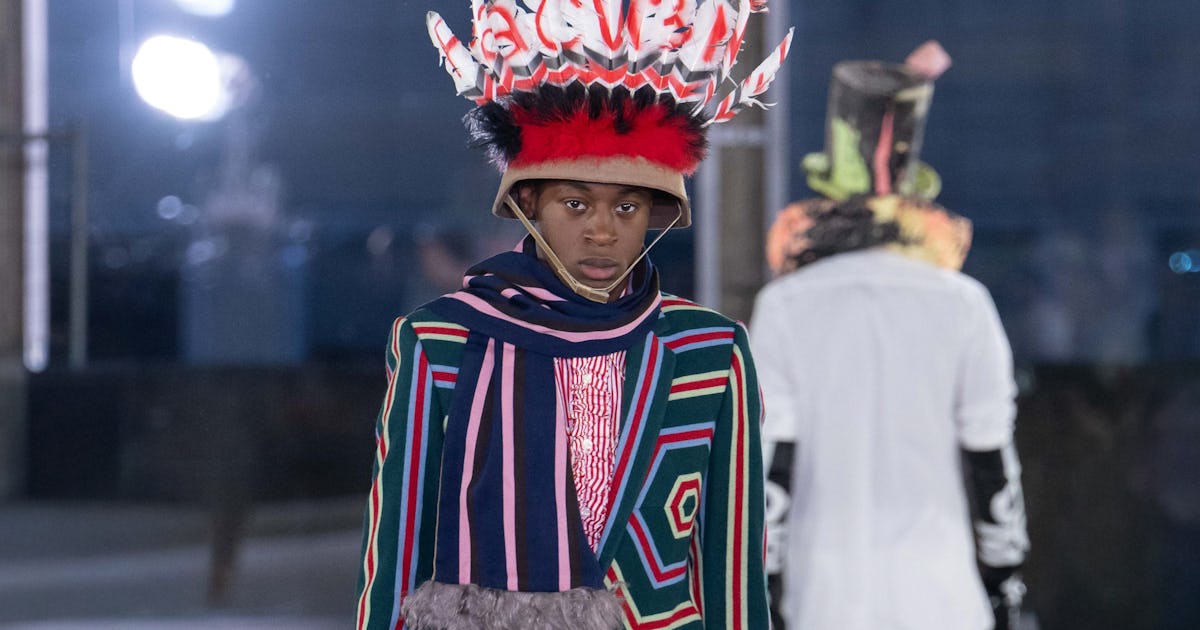
In 1986, a group of unknown designers drove from Belgium to Great Britain to show their work during London Fashion Week. They weren’t given a stage, and few locals could pronounce their names. Along with Martin Margiela (the unofficial seventh), Ann Demeulemeester, Dirk Bikkembergs, Dirk Van Saene, Dries Van Noten, Marina Yee, and Walter Van Beirendonck were labeled the Antwerp Six. They were the first Flemish designers to break through globally; while their aesthetics are distinct, their ethos brought them together. The group was markedly antiglamour, underwritten by a sharp independence and an openness to breaking norms.
This sensibility changed the industry at its core. Today, Belgian designers and designers educated in Belgium still dominate the fashion system. Just look at Matthieu Blazy at Chanel, Pieter Mulier at Versace, Raf Simons at Prada, Julien Dossena (who graduated from La Cambre Mode(s) in Brussels) at Rabanne, Meryll Rogge at Marni, Glenn Martens at Margiela and Diesel, and Anthony Vaccarello at Saint Laurent; then there’s Demna, who famously studied in Belgium and learned under Margiela. Meanwhile, many of the original Six+1 have left fashion altogether, moving onto sculpture, furniture design, and other art forms.
This past week and weekend, the city celebrated the first Antwerp Fashion Festival, inviting the world to get to know the new, rich talent coming out of the unlikely fashion capital. Both new and established Belgian designers were in attendance; Walter Van Beirendonck showed his emotional 40th anniversary collection, 40 Years of Dreaming the World Awake, on the 7th floor of a construction site in an abandoned bank. (The structure was the first skyscraper in Europe—showing in its ruin felt particularly on-brand for the radical pop-conceptual designer.) Dries Van Noten creative director Julian Klausner opened up about how he feels taking the helm from Noten, and how excited he was to meet a designer he loves at the event (Rick Owens). This year’s LVMH Prize finalist, Julie Kegels, put on a group art and design show at the gallery Cour, while the Royal Academy of Fine Arts, Antwerp showcased graduating student collections and invited guests to meet the young designers one-on-one. Designer Tom Van der Borght showed sculptures of real bodies at the Botanic Sanctuary Antwerp and concept shop DONUM, works that broke against the idea that only one form is desirable in the industry.
Walter Van Beirendonck 40th anniversary collection
Courtesy of Walter Van Beirendonck
The Antwerp Fashion Festival events make a strong case for the fact that the city is still a hotbed for avant-garde and independent design. W spoke with 10 of the participating creatives to ask: what makes Antwerp fashion so compelling? And what does the future of fashion look like?
Julian Klausner
Creative director of Dries Van Noten
What do you think about the current state of the industry and its future?
I’m grateful to be part of this big wave of new creative directors. In the season before my start and after, 20 or 30 new creative directors (began). The future seasons are looking really exciting. It’s humbling, as well, because I had my debut show on the same day Haider Ackermann debuted at Tom Ford. I think the morning after was Sarah Burton at Givenchy.
Does Antwerp have a distinct voice in fashion?
This is a very fertile place to be creative. We are quite a particular country: We’re very small and we have three official languages and a messy government and (we’re surrounded) by these great, big histories. As a Belgian, you don’t take yourself too seriously. You are pushed to look at things in a slightly different way.
The state has very little fashion history. So for the first wave of designers, the Antwerp Six, there was everything to be done. There was no weight of heritage or something to be compared to. And that gives a certain creative freedom.
How do you decide between taking creative risks and the demands of the business of fashion? Where do you draw the line?
I’m very instinctive in the way I work. This is what I saw from Dries—I was also aware when I took on the role that I had to find my way. It’s still a work in progress to make the work personal to me. Every season, Dries wanted to push things forward. He was keen on looking to the future. The combination pushes me, still, to be daring. Between being a little bit too daring or being a little bit too bland or commercial, I’d rather lean toward creativity. It is the spirit of the house.
Brandon Wen
Designer and creative director of the fashion department of the Royal Academy of Fine Arts, Antwerp
Describe your brand in three words.
Abstract tropical elegance.
You said the latest collection is about abstraction specifically.
The collection started from the idea of nothing. How does nothing become something? The other note of inspiration is I am originally from Los Angeles. My mother is Spanish, my father is Chinese. So there’s a surfer boy-slash-old Spanish woman inside of me that comes out in the raffia, in the taffeta, in the embroideries.
Who do you picture in the clothes?
I only have a basic answer: Björk, obviously. But I like this collection on boys. I make this clothing for myself. People are like, who’s your client? It’s kind of a Harold and Maude situation.
What are your thoughts on the future of fashion?
We have a lot of students who want to continue creating. But as a fashion designer, it’s hard. You can’t just do that. A painter can make 12 paintings and it’s fine. In fashion, you have to have a collection. For me, the future is in small resources, and finding the people and the communities that will help make that happen. Because right now, I don’t know if a space like that really exists.
How would you define Antwerp fashion?
Antwerp is garment-obsessed. London is more (defined by) abstraction, experimentation. Antwerp is still experimental, but it’s really about garment details. It’s how we teach, it’s what the Six were all about. And historically, it’s always been eclectic.
Walter Van Beirendonck
Member of the Antwerp Six showing his 40th anniversary collection
Tell us about your new collection.
For me, it was a new step, a little more spiritual. The clothes are probably more relaxed, less complicated. I’ve become a little more relaxed, a little less complicated. Also, the world is changing. I’m changing.
How would you describe these 40 years?
As a rollercoaster. I never skipped a season. One way or another, I always put a collection together. I had periods that I really had to survive. Other periods were extremely successful, like the ’90s, with a lot of selling points all over the world. But then again—down and then up, and up and down.
What’s your best memory of these years?
The beginning years were fantastic. You can see it in the exhibition of the Antwerp Six: it was a very naive start because we didn’t know what to do, we didn’t know how to move forward. But at the same time, we were so desperate and ambitious to make it. And it was such an incredible energy, which we all experienced together. That was a nice start to our careers.
What do you see as the future of fashion?
It’s all about creativity—that’s hopefully what can survive and what is so necessary in this fashion world, which has been ruined in the last few years by the big houses, by a lot of money, by mainly concentrating on marketing, by changing designers all the time. We are losing so much of the soul of fashion.
How did you keep going over the years, and what keeps you going today?
In my life, there has always been hope. I’m still fascinated by fashion. It’s still a strong tool to express myself. This last collection is called “I know.” I know that it’s a terrible time. I know that the world is going (through darkness), I know all these things—but still I want to go on and make fashion.
Bernadette de Geyter and Charlotte de Geyter
The mother-daughter designers of women’s ready-to-wear line Bernadette
How would you describe your aesthetic?
Charlotte: We value authenticity, timelessness, optimism, and color.
Do you think Antwerp has a specific sensibility?
Charlotte: Antwerp designers are very down-to-earth. There’s a stubbornness of doing exactly what we want and not being too influenced by what is already happening.
What are your thoughts on the future of the industry?
Charlotte: It changes quickly. With social media, it has already changed so much. So for us, what’s important is that we have slow growth.
Do you have a favorite garment or signature piece?
Bernadette: I always love to wear our robes. It’s a comfort-first garment. You can wear it with a slipper, you can wear it with a heel.
Pommie Dierick
2024 Royal Academy of Fine Arts graduate preparing to launch her own label
Tell us about your work.
I like to work around strong women. My masters collection was about Grace Jones and Bette Davis. I like that energy in a woman, and also in clothing.
Do you work for a designer? Do you have your own line?
I just came back from Paris, actually. I was doing internships, first for Louis Vuitton doing bags, and then I went to Loewe and I did leather there. Now, I work for my own brand.
Is there something that characterizes Antwerp fashion?
There is a certain something you cannot really put in words—we’ve been trying to define it. Antwerp designers are creative, and they put a lot of imagination in their work. You can feel it.
What do you see as the future of fashion?
I’m actually optimistic, because for young designers, it’s more about creativity. The art is coming back, the craft is coming back.
Florentina Leitner
Antwerp-based designer showing her namesake label at Paris Fashion Week
Describe your brand in three words.
Feminine, floral, fantasy.
What are your thoughts on the future of the industry?
I hope the industry will survive what’s going down with wholesale. It’s crazy. It’s important for younger designers to build more B2C and discover their crowd and their direct clients. We’re in very risky times. But I hope it’s settling, and I hope retail is becoming a big thing again. I was in South Korea and Japan last December, and especially in South Korea, I saw amazing stores that were so immersive; it was really an experience.
Carla Lázaro Bonet
2026 Royal Academy of Fine Arts, Antwerp MA graduate, winner of the Jury Prize
Tell us about the concept of your collection.
It was based on my grandmother. I saw her not giving a fuck about social norms. She was doing whatever she wanted, and that was inspiring to me. It’s a balance between contemporary and traditional.
Describe your work in three words.
Craftsmanship, bold, and colorful.
What are your thoughts on the future of the industry?
For me, it’s slowly coming back to craftsmanship. I know this (work) is so time-consuming and exhausting, but at the same time, there is beauty in it. And it’s not about perfection. We need to slow down and work with our hands.
Tom Van der Borght
Designer and artist, winner of the Grand Jury and Public Prize at Hyères 2020
Do you think Antwerp has a specific sensibility?
Antwerp culture is very connected to Belgian culture at large. We are a quite young country; we’re like a collage of people from very different directions. We are dealing less with a strong national identity. And that in itself gives more space for freedom, different approaches, different point of views.
What are your thoughts on the future of the industry?
I always try to approach things in a positive way, but also in a radical way. So I hope for a radical future where we switch our ideas, our ways of producing, our ways of thinking about the body, and also how we deal with each other.
Anna Lackner
2026 Royal Academy of Fine Arts, Antwerp, MA graduate
Tell us about the concept for the collection.
This is so funny, because my collection was inspired by a W magazine shoot—it’s a Juergen Teller shoot from the ’90s with Kate Moss and Claudia Schiffer at the Cannes Film Festival. I love those images so much. I love that there’s still some beauty in this messiness. From this photo shoot, I developed an idea: this diva has a mental breakdown.
When you picture the collection, who do you see wearing it?
Lady Gaga. I think it fits.
What are your hopes or wishes for the future of the industry?
I would love it if people were not too stressed and could be daring and a bit crazy. A lot of people from my class are thinking the same way. There’s a movement—everybody just wants to be free and do what they want without pressure.
Julie Kegels
2026 LVMH Prize finalist who launched her womenswear line in 2024
Describe your brand in a few words.
Stable, fresh, and realistic.
Do you think there is one thing that characterizes Antwerp fashion?
There is something very raw about Antwerp and Belgium in general, and that breeds something ordinary out of daily life. But still, there is a lot of grace. There is also room to dream and have fantasies.
What do you think about the future of fashion?
This is a big industry, and there is a lot of corporate flattening. But on the other hand, there’s something very positive happening because of AI, and things that are too perfect. It actually gives us an opportunity to go more toward craft. You need humans, and the imperfections and the mistakes that humans make. I’m positive, of course, because I just started, I have to be positive. Maybe I’m still a bit naive, and maybe it’s also good to dream.
